
Fun & Factopedia logoFun & Factopedia
Homeβ€ΊArticlesβ€ΊThe Toba Supervolcano: When Humanity Nearly Went Extinct

Ancient Earth

The Toba Supervolcano: When Humanity Nearly Went Extinct

About 74,000 years ago, one of the largest volcanic eruptions in Earth's history may have pushed our ancestors to the edge of extinction. Scientists continue to debate just how close humanity came to disappearing forever.

🟒 editors-pick⏱ 3 min readVersion 1.0
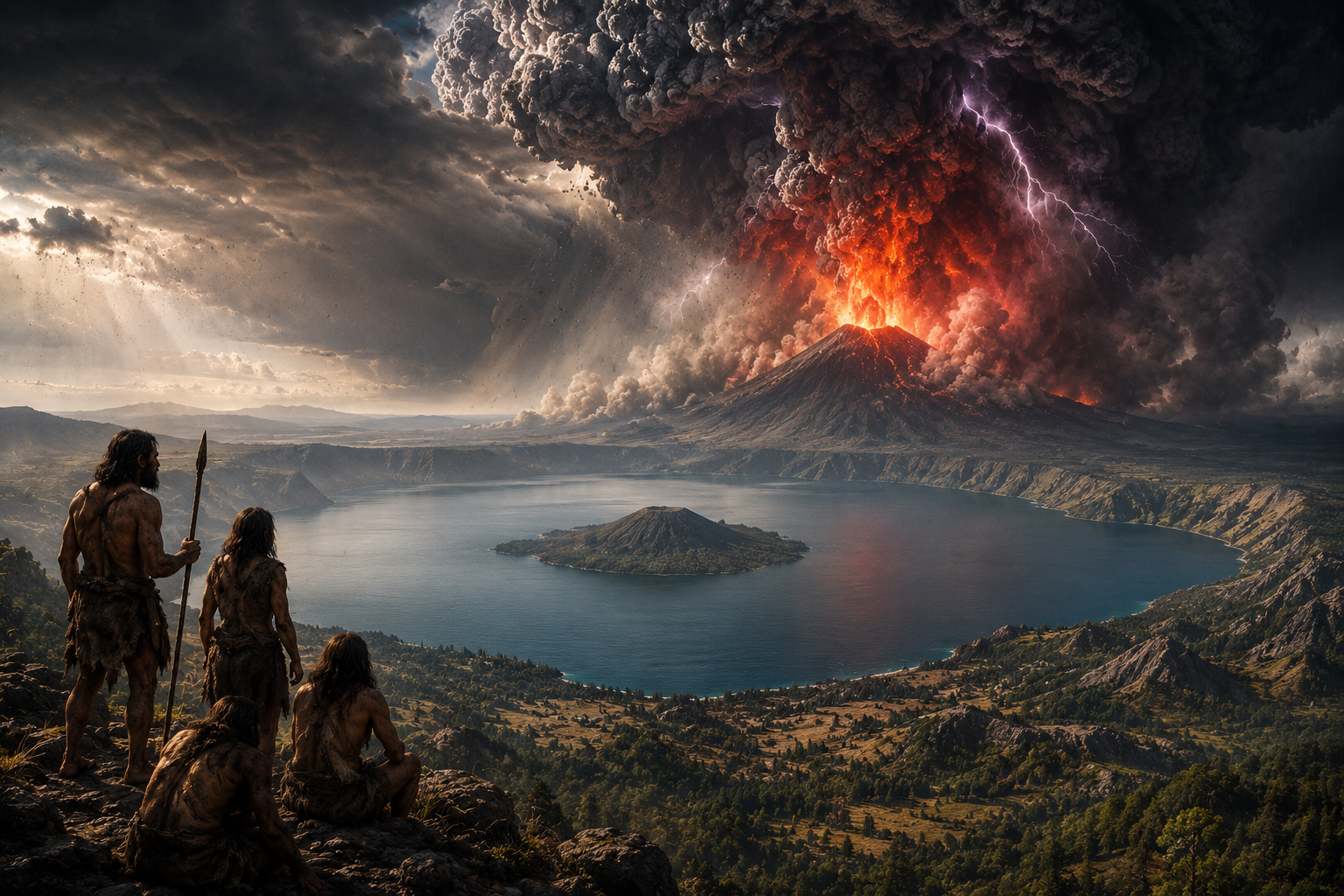
A dramatic aerial view of Lake Toba in Indonesia, showing the vast volcanic caldera surrounded by mountains as a colossal prehistoric supervolcano erupts in the distance, sending towering ash clouds into the sky while early humans watch from afar.

Confidence

🟒 editors-pick

Published

July 2026

Last Updated

July 2026

Version

1.0

⚑ Quick Answer

Around 74,000 years ago, the Toba supervolcano on the Indonesian island of Sumatra produced one of the largest known volcanic eruptions in Earth's history. Some scientists have proposed that the eruption caused a population bottleneck that drastically reduced the number of surviving humans, although the extent of its impact remains an active area of scientific research.

Did You Know?

  • β—Ž Lake Toba occupies the massive caldera left by the ancient super-eruption.
  • β—Ž The eruption occurred approximately 74,000 years ago.
  • β—Ž It is considered one of the largest volcanic eruptions in the past two million years.
  • β—Ž Some scientists proposed the Toba catastrophe theory to explain a possible human population bottleneck.
  • β—Ž Researchers continue to debate how severely the eruption affected early humans.

Full Story

The Toba Supervolcano: When Humanity Nearly Went Extinct

Around **74,000 years ago**, Earth experienced one of the most powerful volcanic eruptions ever known.

It came from what is now **Lake Toba** on the Indonesian island of Sumatra.

An Explosion Beyond Imagination

The Toba eruption released thousands of cubic kilometers of volcanic material into the atmosphere.

Ash covered huge parts of South Asia, while sulfur gases reached the upper atmosphere, potentially reducing global temperatures for years.

Today, the enormous caldera left behind is filled by **Lake Toba**, the largest volcanic lake on Earth.

The Human Bottleneck Theory

Some scientists believe the eruption triggered a dramatic decline in the global human population.

This idea, known as the **Toba catastrophe theory**, suggests that only a relatively small number of humans survived the environmental changes.

If true, every person alive today would trace their ancestry back to those survivors.

A Continuing Scientific Debate

Not all researchers agree.

Archaeological discoveries in Africa and India suggest that some human populations may have survived with less disruption than originally proposed.

Most scientists agree the eruption was enormous, but they continue to debate exactly how much it affected early humans.

One of Earth's Greatest Natural Events

Whether or not it nearly wiped out humanity, the Toba eruption remains one of the most powerful volcanic events in the last two million years.

Its legacy can still be seen today in the breathtaking Lake Toba, a reminder of the incredible forces hidden beneath Earth's surface.

FAQ

What is the Toba supervolcano?

It is a massive volcanic system beneath Lake Toba in Sumatra, Indonesia.

When did the Toba eruption occur?

Approximately 74,000 years ago.

Did the eruption nearly wipe out humanity?

Some scientists believe it caused a severe population bottleneck, while others argue the impact on humans was less extreme. The question remains under scientific debate.

Where is Lake Toba?

Lake Toba is located on the Indonesian island of Sumatra.

Is Toba still an active volcano?

Yes. It is classified as an active volcanic system, although another super-eruption is considered extremely unlikely in the foreseeable future.