
Full Story
The Accidental Discovery That Created Super Glue
Imagine inventing one of the world's most useful products...
...and throwing it away because it was too sticky.
That's exactly what happened.
A Wartime Research Project
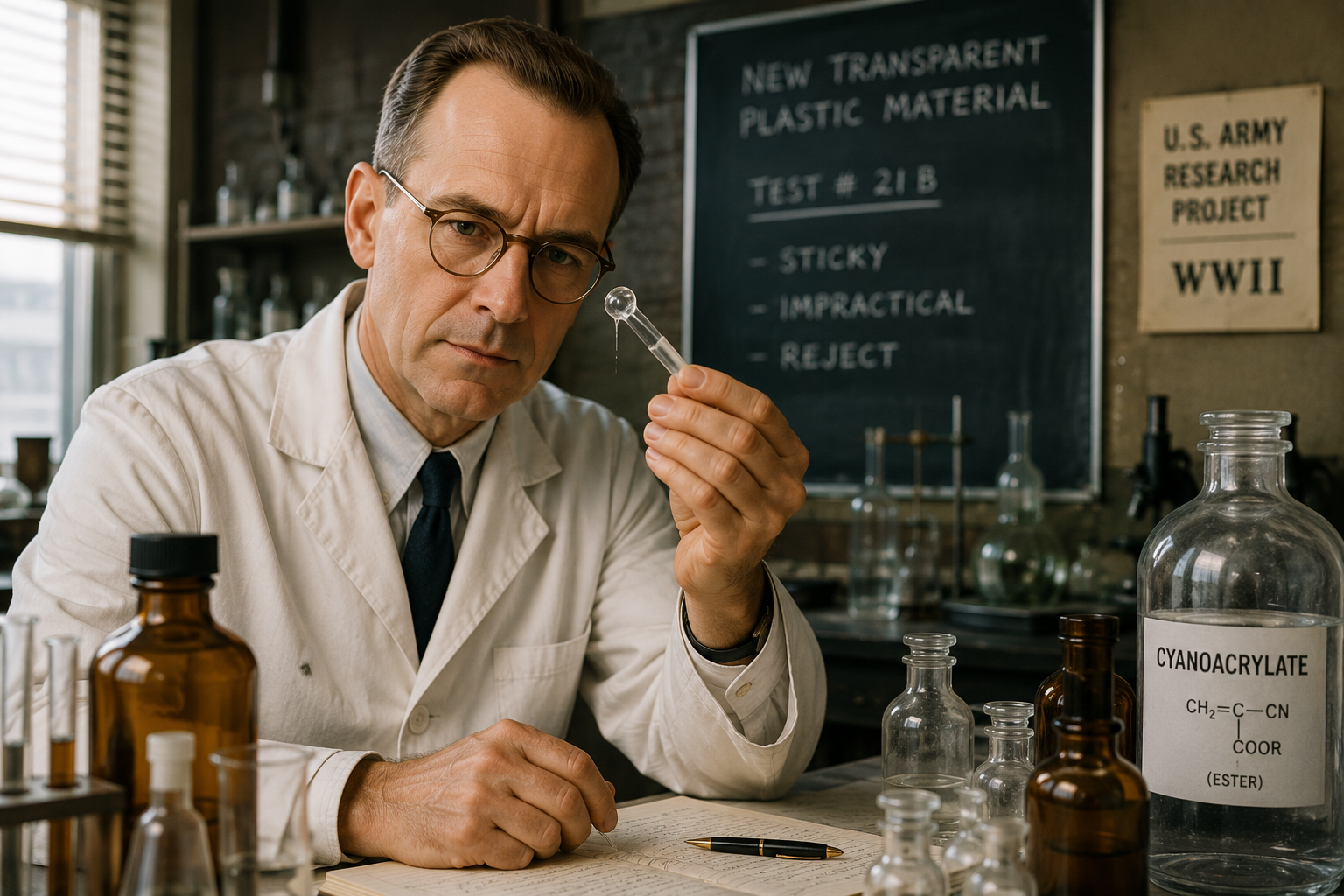
In 1942, American chemist Harry Coover was working for Eastman Kodak.
His team was searching for clear plastic materials that could be used in precision gun sights during World War II.
While testing different chemicals, they created a compound called cyanoacrylate.
A "Failed" Experiment
The new material immediately stuck to almost everything it touched.
Glass.
Metal.
Laboratory equipment.
Even the scientists' fingers.
Because it was impossible to handle during manufacturing, the team dismissed it as a failure and moved on.
Rediscovered Years Later
Nearly a decade later, in 1951, Harry Coover encountered cyanoacrylate again while working on a different project.
This time, he realized that its extreme stickiness wasn't a flaw.
It was exactly what made it valuable.
The Birth of Super Glue
The adhesive was refined and introduced commercially in 1958 under the name Super Glue.
People quickly discovered it could bond wood, metal, rubber, ceramics, plastics, and many other materials within seconds.
It became one of the most successful adhesives ever invented.
Saving Lives
Super Glue isn't just useful around the house.
Special medical versions of cyanoacrylate adhesives are now used to close wounds, seal surgical incisions, and reduce the need for stitches in certain procedures.
One Happy Accident
Today, billions of people have used Super Glue.
Its incredible strength all began because scientists accidentally created something they thought was completely useless.
Sometimes, the biggest breakthroughs come from experiments that seem like failures.