
Full Story
Part of Your Mother May Still Be Living Inside Your Brain
Imagine carrying a tiny part of your mother with you...
for the rest of your life.
According to modern biology, that may actually be true.
A Two-Way Exchange
During pregnancy, the placenta allows nutrients and oxygen to pass between mother and baby.
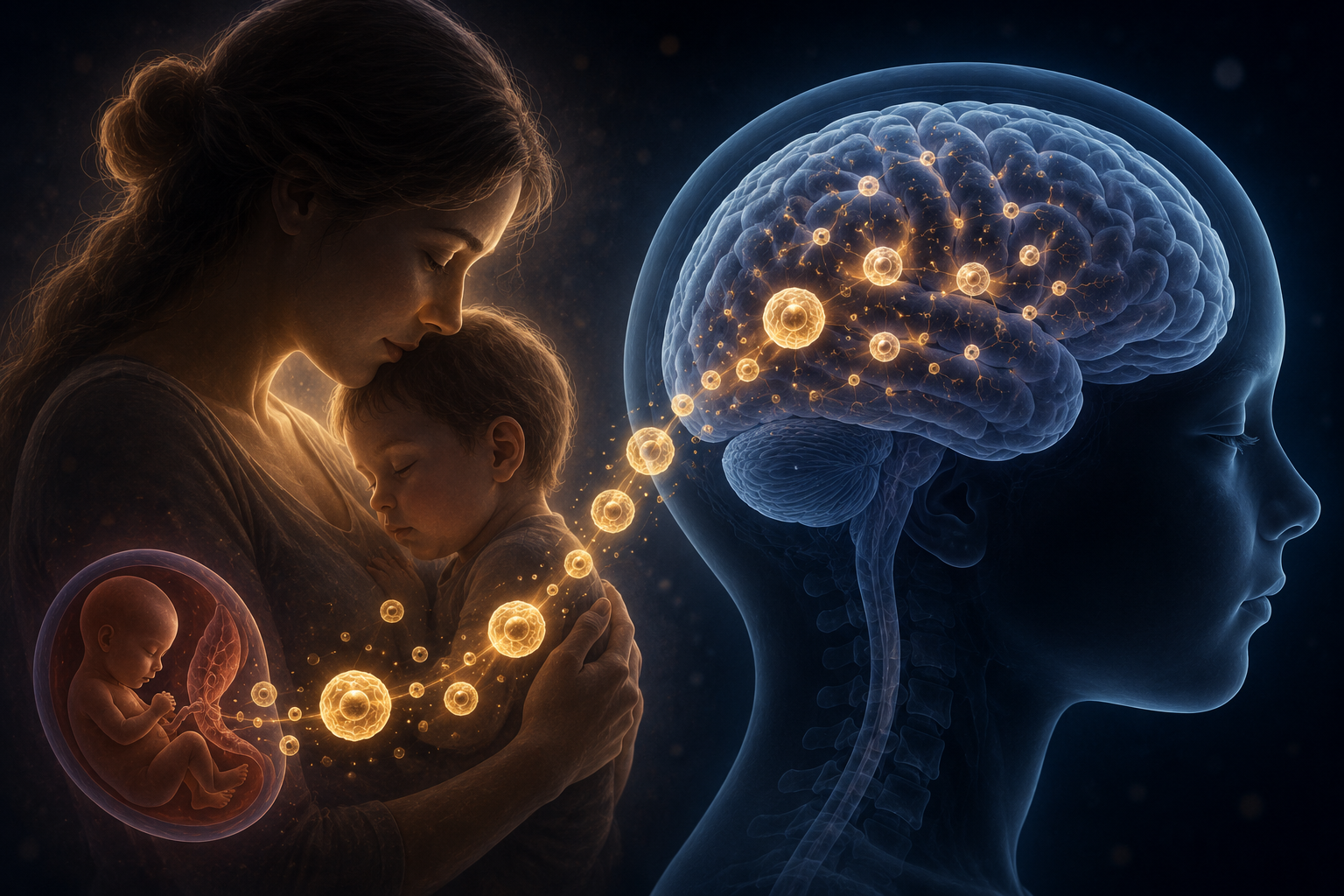
Scientists have also discovered that a small number of living cells cross the placenta in both directions.
Some fetal cells enter the mother's body.
Likewise, some maternal cells enter the developing baby.
This phenomenon is known as microchimerism.
Reaching the Brain
Researchers have found maternal cells in many organs, including the liver, heart, skin, blood, and even the human brain.
One study detected maternal cells in 63% of the female brains that were examined after death.
These cells were found decades after birth, demonstrating that some maternal cells can survive for an extraordinarily long time.
What Are These Cells Doing?
This is where the mystery begins.
Scientists still do not know exactly what these cells do.
Some researchers believe they may help with tissue repair or healing after injury.
Others think they could influence how the immune system develops or responds to disease.
There is also ongoing research into whether microchimerism may play a role in certain autoimmune diseases or neurological conditions.
At present, none of these possibilities has been conclusively proven.
A Lifelong Connection
The number of maternal cells is extremely small compared with the trillions of cells in the human body.
They do not change your personality, memories, or thoughts.
Instead, they represent a fascinating biological reminder that pregnancy creates a lasting cellular connection between mother and child.
A Discovery Still Being Explored
Microchimerism has become one of the most intriguing areas of modern medical research.
Every year, scientists learn more about how these rare cells survive and interact with the body.
Their exact purpose remains unknown.
But one thing is certain.
Long after pregnancy ends, a tiny part of your mother may still be with you.