
Full Story
Project Pigeon: The World War II Missile Guided by Birds
During World War II, scientists were searching urgently for better ways to guide weapons toward moving or difficult targets.
Psychologist B. F. Skinner believed he had an unusual solution.
Pigeons.
Why Pigeons?
Skinner was already famous for his work on animal behavior and operant conditioning.
He knew that pigeons could be trained to perform very precise actions in exchange for food rewards.
His idea was to use that reliability as part of a guidance system.
Instead of asking a machine to recognize a target, the pigeon would do it.
How the System Worked
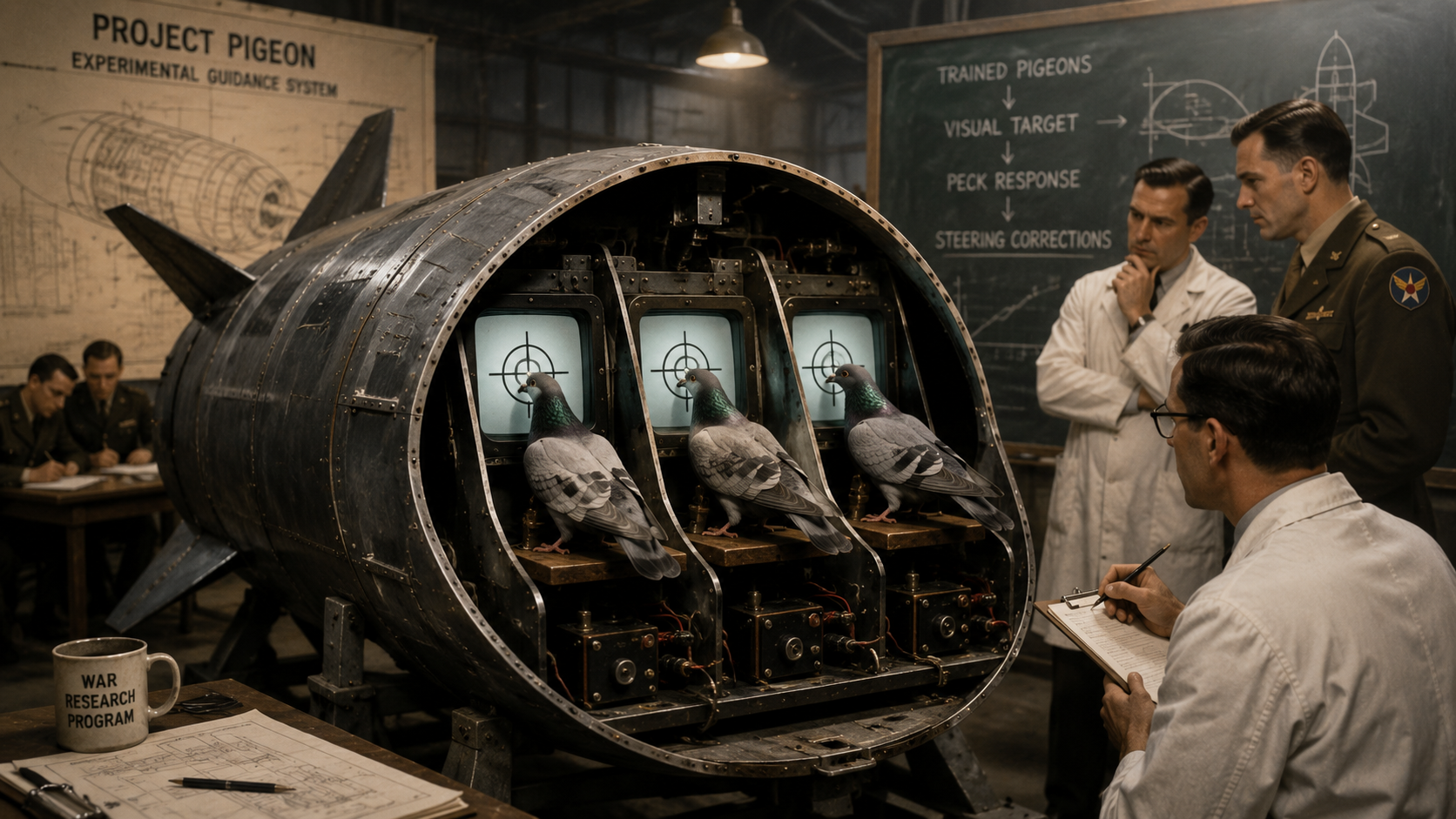
Inside the proposed weapon, the pigeon would face a screen displaying an image of the target.
The bird had been trained to peck directly at the target.
As long as the target remained in the center of the screen, the pigeon would continue pecking near the middle.
If the target drifted to one side, the pigeon would follow it with its beak.
Those off-center pecks could then be translated into steering corrections that would guide the weapon back toward the target.
In effect, the pigeon became part of the control system.
Why Three Pigeons?
One version of the design used three pigeons rather than a single bird.
Each pigeon watched an image of the target and responded independently.
Using multiple birds offered an important advantage: their responses could be compared.
If two pigeons indicated one direction while the third responded differently, the system could rely on the majority response.
This redundancy was intended to make the guidance system more reliable.
Did It Actually Work?
The idea sounds absurd, but Skinner's demonstrations reportedly showed that pigeons could track visual targets with impressive consistency.
The birds were highly trainable and could continue pecking even while the apparatus moved around them.
The biggest obstacle was not necessarily the pigeons.
It was convincing military officials that a weapon guided by birds was worth pursuing when electronic guidance systems were also advancing rapidly.
Why Was Project Pigeon Canceled?
The project received military funding for a period, but support was eventually withdrawn.
As electronic guidance technologies improved, they offered a more conventional path toward precision weapons.
The pigeon system never reached operational deployment.
Skinner later continued developing related ideas under another program called Project Orcon, a name derived from “organic control.”
That effort also ended without producing a combat weapon.
One of World War II's Strangest Experiments
Project Pigeon was never used on the battlefield, but it was not simply a joke.
It was a genuine attempt to solve a difficult engineering problem using animal behavior at a time when modern computing did not exist.
The experiment remains one of the clearest examples of how wartime research can produce ideas that seem bizarre today, yet were surprisingly logical within the technology of their time.