
Full Story
Project Habakkuk: Britain’s Incredible Plan for an Aircraft Carrier Made of Ice
During the darkest years of World War II, Allied convoys crossing the Atlantic faced a serious problem.
German U-boats and aircraft could attack ships in areas that were difficult for land-based Allied aircraft to protect.
One proposed solution was extraordinary:
Build a gigantic floating airfield.
And make much of it from ice.
The Mid-Atlantic Problem
Aircraft played an important role in protecting Atlantic convoys, but early in the war their limited range left portions of the ocean difficult to cover effectively.
British inventor Geoffrey Pyke proposed creating enormous floating platforms that could provide aircraft bases far from land.
Steel was desperately needed for conventional ships, tanks, weapons and other military equipment.
Ice, by comparison, was cheap and abundant.
There was one obvious problem.
Ice melts.
The Discovery of Pykrete
Researchers found that mixing water with a relatively small proportion of wood pulp produced a frozen composite with remarkable properties.
The material became known as pykrete, a name associated with Geoffrey Pyke and researcher Max Perutz.
The wood fibers reinforced the ice, making the resulting material considerably tougher than ordinary frozen water.
It also melted more slowly.
Pykrete could withstand impacts that would easily fracture a normal block of ice, making the idea of an ice-based structure considerably less absurd than it initially sounded.
A Colossal Frozen Aircraft Carrier
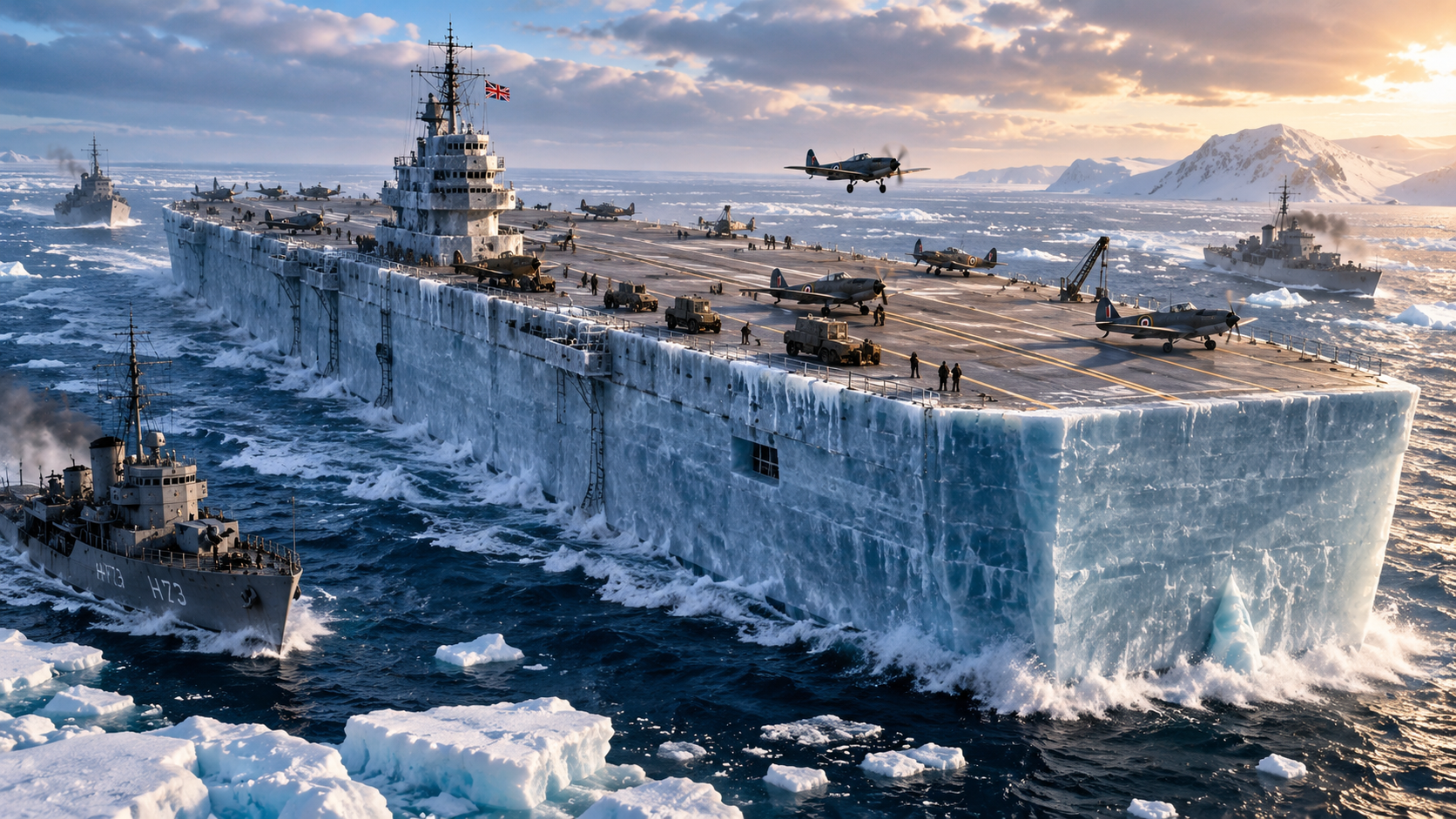
The proposed Habakkuk vessel was not going to resemble an ordinary aircraft carrier.
Plans examined a structure hundreds of meters long with enormously thick walls and a displacement measured in millions of tons.
Its immense flight deck could potentially accommodate aircraft while the vessel operated as a mobile airbase in the Atlantic.
The scale was essential because a gigantic mass of frozen material would melt much more slowly than a smaller block.
But the ship could not simply be frozen once and launched.
Keeping an Ice Ship Frozen
Pykrete melted more slowly than ordinary ice, but it still melted.
That meant Habakkuk would require an extensive refrigeration system running through the structure to keep the material frozen.
The vessel would also need insulation, structural reinforcement, machinery, electrical systems, propulsion and conventional materials such as steel.
The more engineers investigated the concept, the more complicated the supposedly inexpensive ice ship became.
The Prototype in Canada
Project Habakkuk progressed beyond drawings and laboratory experiments.
In 1943, engineers constructed a small experimental structure on Patricia Lake in Jasper National Park, Alberta, Canada.
The prototype was roughly 18 meters long and used refrigeration equipment to test whether a frozen structure could be maintained through warmer conditions.
The experiment demonstrated that the basic concept was technically possible.
Building a full-scale ocean-going vessel, however, was an entirely different challenge.
Why Was Project Habakkuk Abandoned?
By the time the project was being seriously evaluated, the military situation was changing.
Longer-range aircraft were improving Allied coverage over the Atlantic.
Escort carriers provided mobile air support using proven shipbuilding technology.
Radar and anti-submarine warfare techniques were advancing.
New airfields also expanded the territory from which aircraft could operate.
Meanwhile, estimates for Habakkuk revealed that the vessel would require tremendous quantities of materials, machinery, insulation and refrigeration equipment.
Its enormous size would also make construction lengthy and expensive.
The advantage of building a cheap ship from abundant ice was gradually disappearing.
The Ice Carrier That Never Sailed
The full-size Project Habakkuk vessel was never constructed.
The Canadian prototype was eventually abandoned, and its refrigerated structure slowly melted back into Patricia Lake.
Today, remnants associated with the experiment remain beneath the water.
Project Habakkuk is remembered because it sounds almost impossible.
Yet behind the strange idea was a genuine wartime engineering problem and an equally genuine attempt to solve it.
Britain and its allies really did investigate whether one of the world's largest ships could be built largely from frozen water and wood pulp.
For a brief moment during World War II, an aircraft carrier made of ice was not science fiction.
It was an engineering project.