
Full Story
The Wow! Signal: The 72-Second Mystery From Space
On August 15, 1977, Ohio State University's Big Ear radio telescope was scanning the sky for unusual radio emissions.
The telescope had been participating in one of the longest-running searches for signals that might come from extraterrestrial technology.
That night, it recorded something remarkable.
A Signal Hidden in a Printout
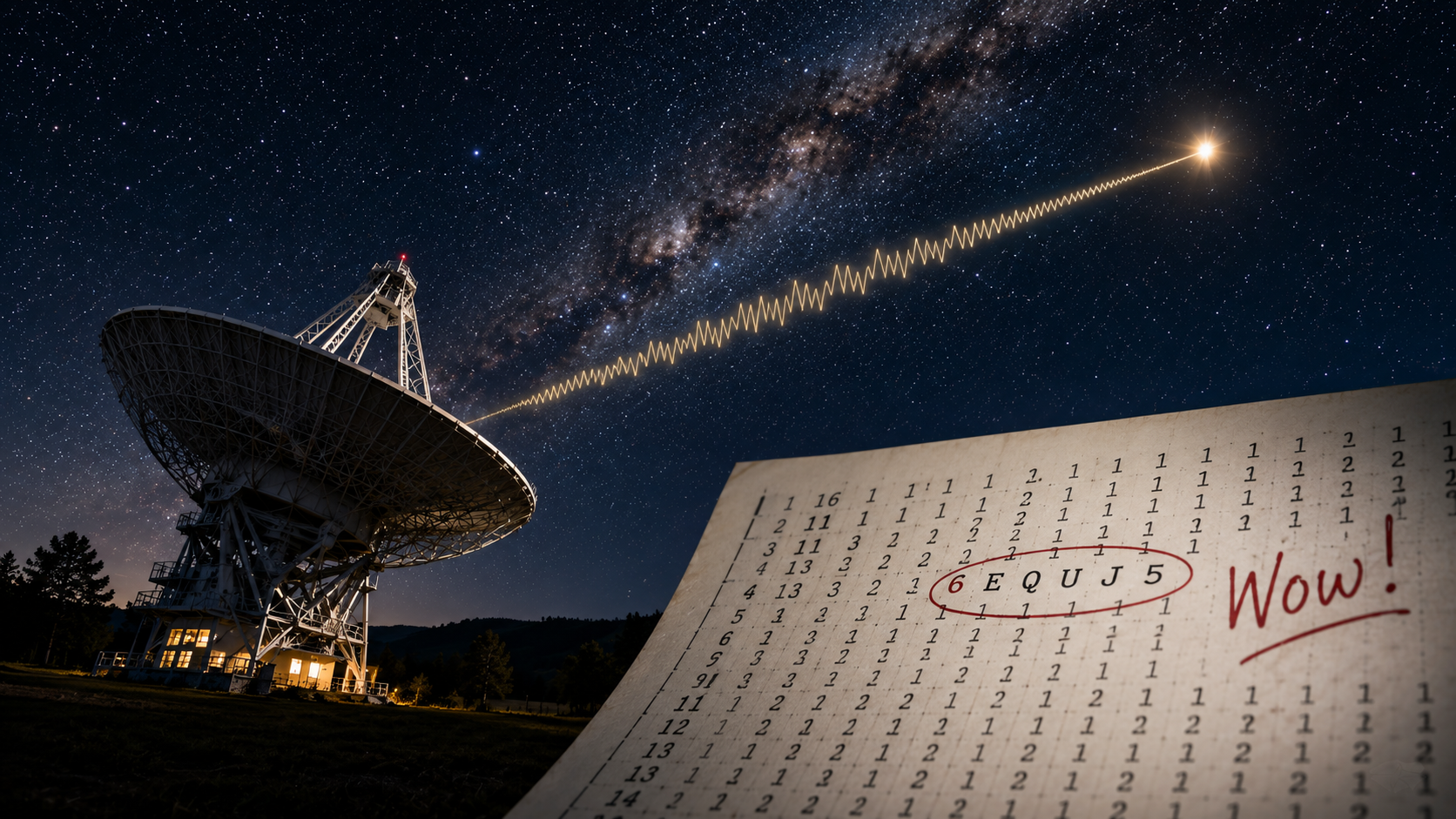
The telescope's observations were converted into rows of letters and numbers on a paper printout.
The following day, volunteer astronomer Jerry Ehman reviewed the data and noticed an unusually strong sequence:
6EQUJ5
The characters did not contain a message.
They represented the changing strength of the radio signal over six consecutive measurements.
The signal grew stronger, reached a peak, and then faded in a pattern that closely matched the way a distant astronomical source would move through the telescope's beam as Earth rotated.
Ehman circled the sequence and wrote a single word beside it:
Wow!
The name remained.
Why Did It Last 72 Seconds?
Big Ear was a fixed telescope. It did not track objects across the sky.
Instead, Earth's rotation carried different regions of space through its field of view.
A source at a fixed position in the sky would therefore remain within the telescope's beam for approximately 72 seconds.
That is exactly how long the Wow! Signal lasted.
This duration was not evidence that the transmitter itself operated for only 72 seconds. It was the maximum amount of time the telescope could observe a fixed source during a single pass.
What Made the Signal Unusual?
The signal had several characteristics that attracted attention.
It was:
◎ Extremely strong compared with the surrounding radio noise
◎ Concentrated within a narrow range of frequencies
◎ Consistent with a source fixed in the sky
◎ Detected near a frequency considered scientifically interesting for interstellar communication
Narrowband signals are noteworthy because most natural cosmic radio sources produce energy across broader ranges of frequencies.
However, an unusual signal is not automatically an alien transmission.
What Did 6EQUJ5 Mean?
The sequence 6EQUJ5 described the signal's intensity.
Big Ear used numbers for lower signal levels and letters for higher values. The letter U represented the highest intensity recorded during the event.
The sequence showed the signal rising from a moderate level to an exceptional peak before falling again.
It was not coded language, coordinates, or a message from space.
Why Was It Detected Only Once?
Big Ear used two separate beams to observe the same region of sky several minutes apart.
Most persistent astronomical sources would normally appear in both beams.
The Wow! Signal appeared in only one.
This suggests that the source may have stopped transmitting before the second beam reached it, begun after the first beam had passed, varied rapidly, or resulted from an unusual form of interference.
Astronomers repeatedly searched the same region afterward, but the signal was never conclusively detected again.
Did It Come From Aliens?
There is no confirmed evidence that the Wow! Signal came from an extraterrestrial civilization.
Its properties made it interesting to SETI researchers, but a single unrepeatable detection is not enough to identify its source.
Possible explanations have included:
◎ An unusual natural astronomical event
◎ Human-made radio interference
◎ A passing satellite or reflected transmission
◎ A temporary source that has not yet been identified
◎ A technological signal from beyond Earth
None of these explanations has been conclusively proven.
Why the Mystery Remains
Science depends on repeatable observations.
If astronomers could detect the same signal again, they could study its exact location, frequency, polarization, and behavior.
Because the Wow! Signal appeared only once, researchers were left with a short printout and a limited set of measurements.
Nearly five decades later, the signal remains one of the most intriguing events in the history of the search for extraterrestrial intelligence.
It may have been an unusual natural phenomenon.
It may have been interference.
It may have been something else entirely.
For now, the Wow! Signal remains exactly what its name suggests: a brief moment that made astronomers stop and wonder.