
Full Story
Socotra Island: Yemen's Alien Island That Shouldn't Exist
If someone showed you photos of Socotra without telling you where it was, you might assume they came from another planet.
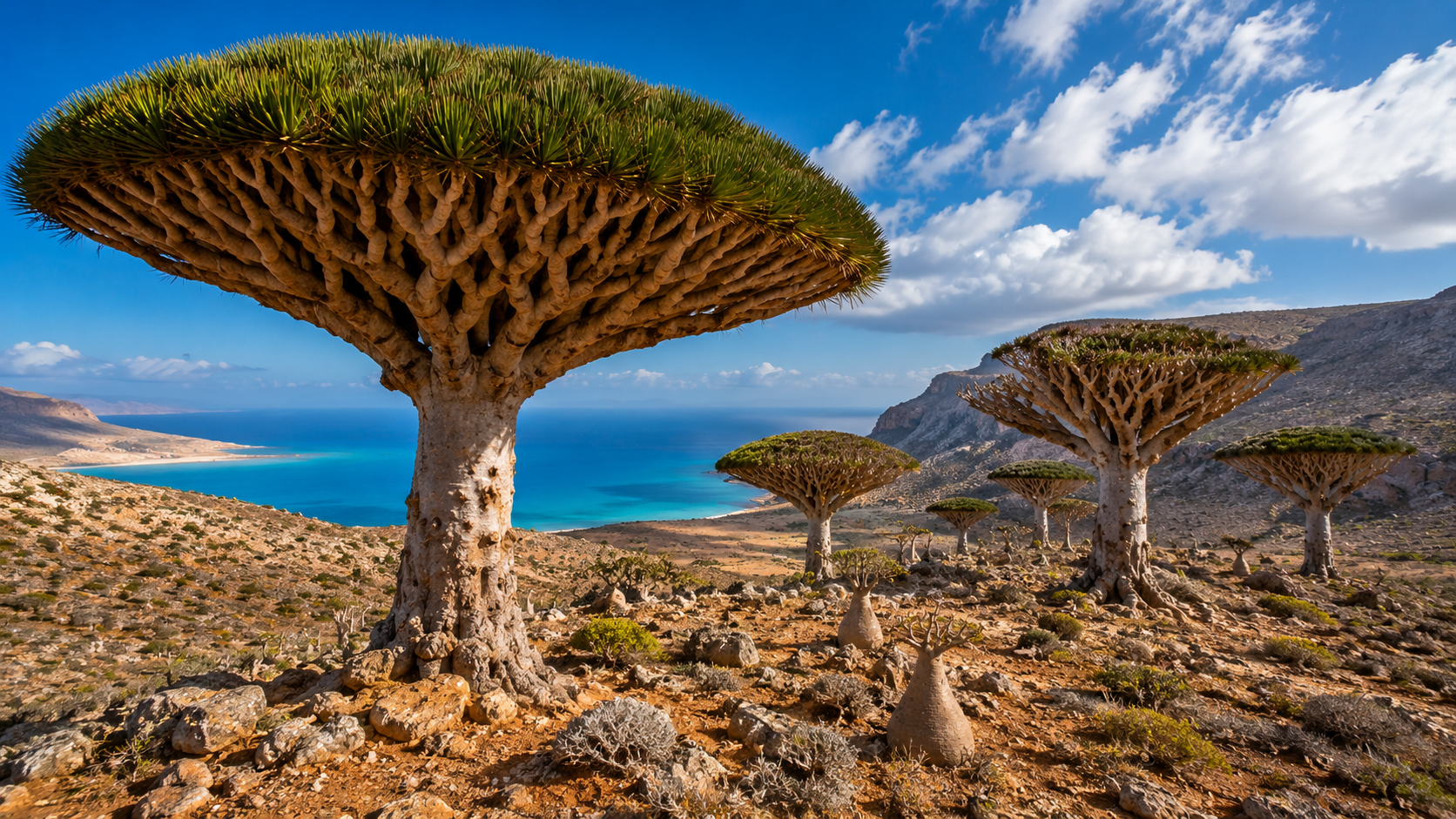
The island's strange trees and bizarre landscapes look almost computer-generated.
Yet everything here is completely real.
An Island Frozen in Time
Socotra lies in the Arabian Sea about 380 kilometers (240 miles) south of mainland Yemen.
For millions of years, it remained isolated from other landmasses.
That isolation allowed plants and animals to evolve independently, creating one of the most unique ecosystems on Earth.
The Famous Dragon Blood Tree
Socotra's most recognizable resident is the Dragon Blood Tree.
Its giant umbrella-shaped canopy resembles an enormous mushroom floating above the rocky landscape.
The tree produces a deep red resin known as "dragon's blood," which has been used for medicine, dyes, varnishes, and incense for thousands of years.
Life Found Nowhere Else
Nearly 37% of the island's plant species, around 90% of its reptile species, and about 95% of its land snails are found nowhere else on Earth.
Scientists consider Socotra one of the planet's most important biodiversity hotspots.
A UNESCO World Heritage Site
Because of its remarkable biodiversity, UNESCO designated Socotra a World Heritage Site in 2008.
The island is often compared to the Galápagos Islands because both locations provide scientists with valuable insights into evolution and adaptation.
A Landscape That Defies Reality
Towering limestone mountains, white sand dunes, turquoise beaches, caves, and surreal forests combine to create scenery unlike anywhere else.
Many filmmakers and photographers describe Socotra as Earth's closest equivalent to an alien world.
Nature's Greatest Experiment
Socotra reminds us that when nature is left undisturbed for millions of years, evolution can create life forms beyond imagination.
It isn't another planet.
It simply feels like one.