
Full Story
Salar de Uyuni: The Giant Mirror That Shouldn't Exist
Imagine standing on a surface so perfectly reflective that the horizon disappears.
That's exactly what happens at Salar de Uyuni in Bolivia.
Covering more than 10,500 square kilometers (4,000 square miles), it is the largest salt flat on Earth.
A Prehistoric Origin
Thousands of years ago, the region was covered by enormous lakes.
As those lakes gradually evaporated, they left behind vast layers of salt and minerals.
The result was a dazzling white landscape stretching farther than the eye can see.
The World's Largest Mirror
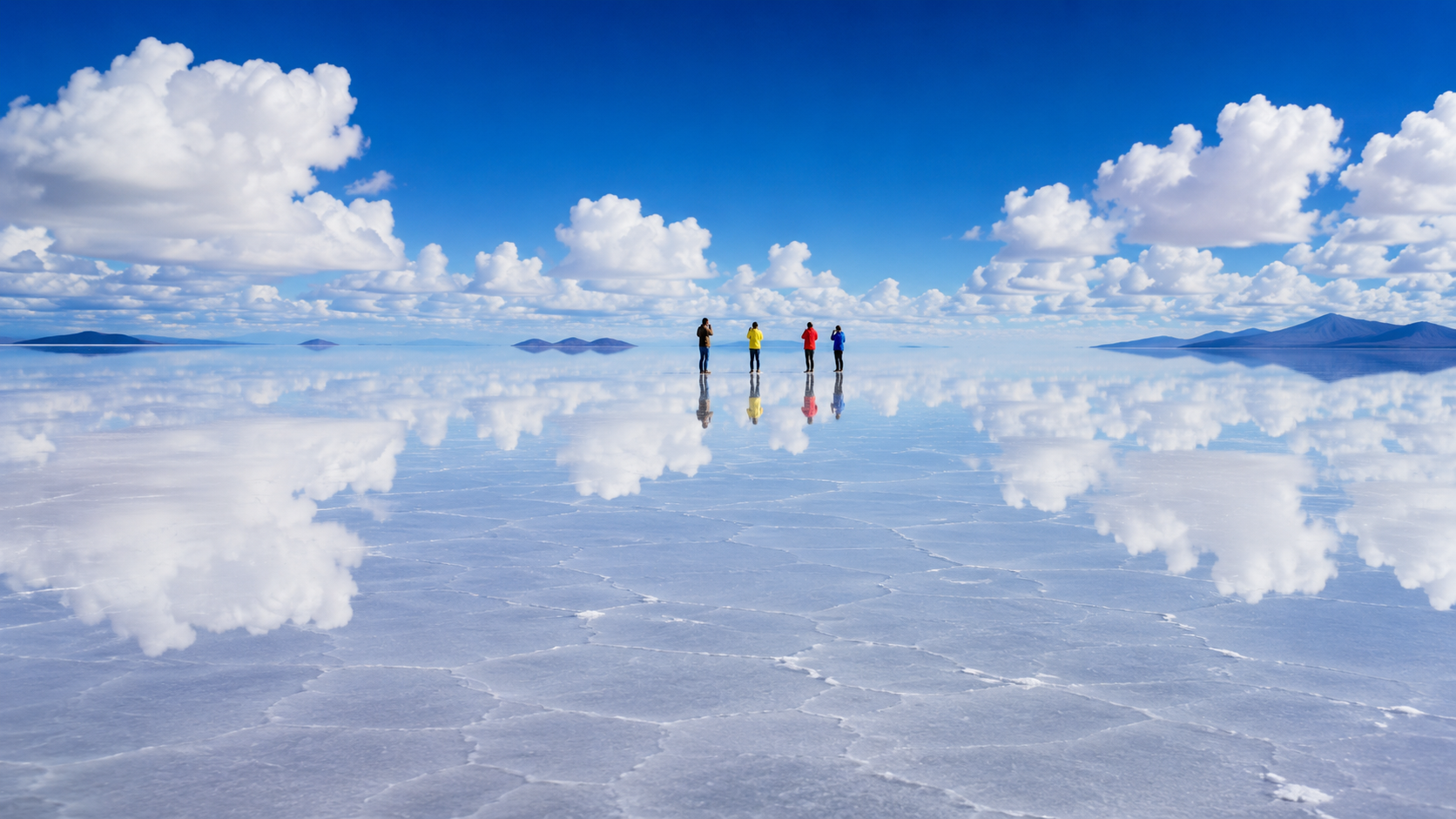
During the rainy season, a shallow layer of water forms across the flat surface.
Because Salar de Uyuni is remarkably level, the water creates an almost perfect reflection of the sky.
Clouds, sunsets, and stars appear both above and below, making visitors feel as though they are floating among the heavens.
A Photographer's Dream
The mirror effect has made Salar de Uyuni one of the most photographed places in the world.
Its endless horizon creates optical illusions and perspective tricks that have become famous on social media.
A Treasure Beneath the Surface
Salar de Uyuni contains one of the world's largest reserves of lithium, an essential element used in rechargeable batteries for smartphones and electric vehicles.
Scientists believe the salt flat may contain more than 20 percent of the planet's known lithium resources.
A Tool for Space Exploration
Because of its extraordinary flatness, satellite agencies use Salar de Uyuni to calibrate instruments orbiting Earth.
Few natural landscapes are as useful—or as beautiful.
A Place That Feels Like Another World
Whether covered in brilliant white salt or transformed into a giant mirror, Salar de Uyuni looks impossible.
Yet this breathtaking wonder exists right here on Earth, proving that nature can create landscapes more incredible than imagination.