
Full Story
Fogbows: The Almost Colorless Rainbows Hidden in Fog
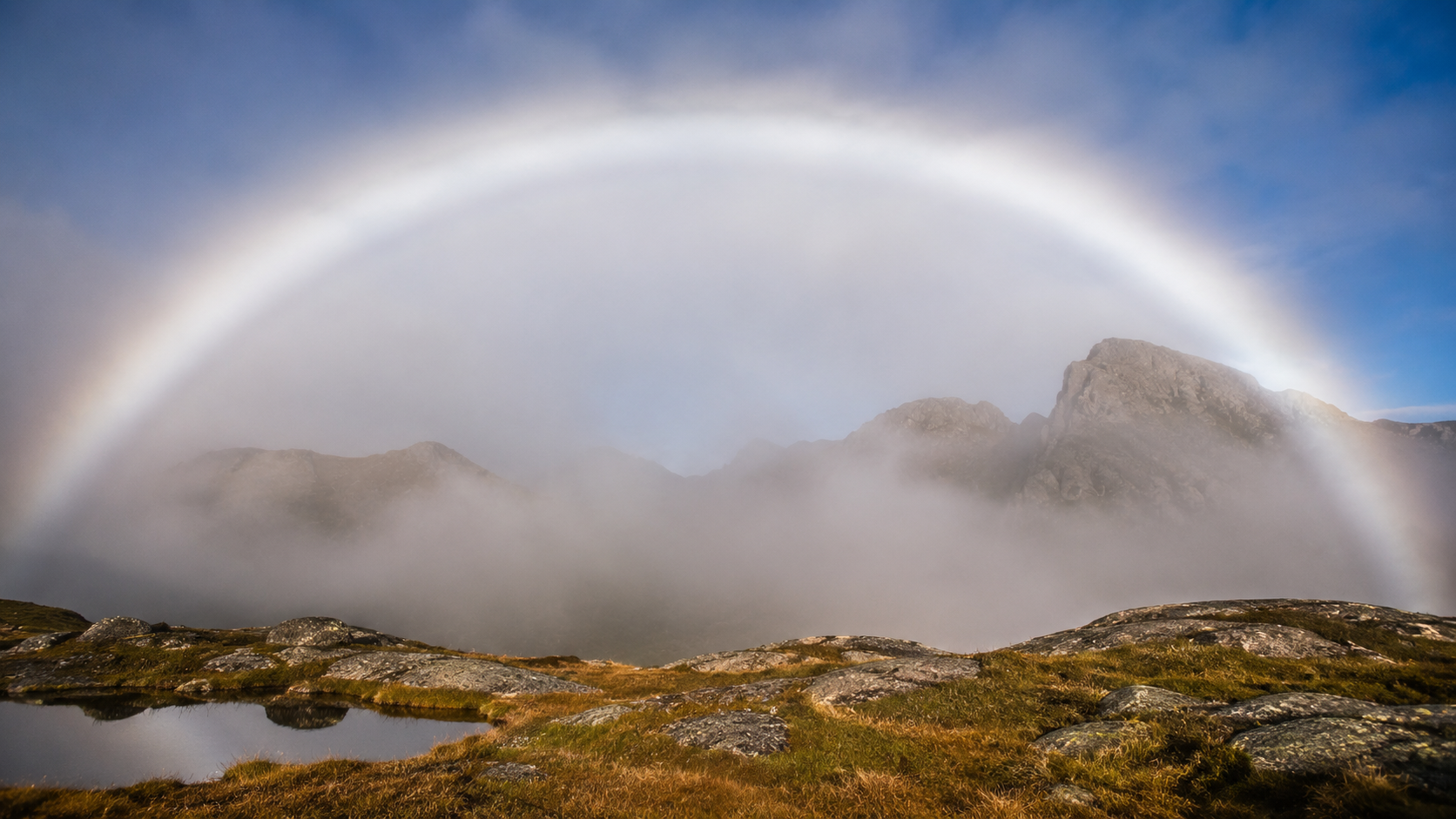
Imagine seeing a huge rainbow stretching across the landscape, except almost every color has disappeared.
The arc is broad, pale and sometimes nearly pure white.
This unusual sight is a fogbow, one of the atmosphere's most beautiful optical phenomena.
A Rainbow Made From Fog
Ordinary rainbows form when sunlight enters water droplets in the atmosphere.
The light is refracted as it enters a droplet, reflected inside it and refracted again as it leaves. Different wavelengths of visible light emerge at slightly different angles, producing the familiar spectrum of colors.
Fogbows begin with a similar interaction between sunlight and water.
The crucial difference is the size of the droplets.
Fog itself consists of extremely small water droplets suspended close to the ground.
Where Did All the Colors Go?
The colors are not actually missing.
They are overlapping.
The tiny droplets inside fog are small enough that diffraction becomes particularly important. Instead of producing the sharply separated colors we associate with a normal rainbow, the light spreads out more broadly.
The different color bands overlap one another so extensively that they largely blend back together.
What remains is a broad, pale arc that often looks white.
Under favorable conditions, subtle colors may still be visible. A fogbow can sometimes show a faint reddish outer edge and a bluish inner edge.
But compared with an ordinary rainbow, the colors are remarkably weak.
Why Is a Fogbow Wider Than a Rainbow?
Fogbows do not merely look paler.
Their arcs also tend to appear broader than ordinary rainbows.
Again, diffraction is responsible. The light is spread across a wider angular range by the tiny fog droplets, creating a softer and less sharply defined bow.
The result can look almost supernatural: an enormous white arch suspended silently in the mist.
How Can You See One?
The geometry is similar to seeing an ordinary rainbow.
You generally need the Sun behind you and fog or mist containing water droplets in front of you. Ordinary rainbows require the same basic arrangement of sunlight, droplets and observer.
Fogbows can be particularly striking from elevated locations where sunlight shines onto a bank of fog below.
They may also appear alongside another atmospheric optical phenomenon called a glory, which consists of colored rings that can form around the observer's shadow.
A Rainbow Without the Rainbow Colors
A fogbow demonstrates how dramatically the size of a water droplet can change what we see.
Sunlight is still there.
Water droplets are still there.
The familiar arc is still there.
Yet make those droplets small enough, and the brilliant bands of a rainbow blur together into an almost ghostly white bow.
Nature did not remove the colors.
It simply blended them together.