
Fun & Factopedia logoFun & Factopedia
Homeβ€ΊArticlesβ€ΊThe Accidental Invention of the Pacemaker

Accidental Inventions

The Accidental Invention of the Pacemaker

A tiny electronic mistake changed medical history forever. While building a heart monitor, engineer Wilson Greatbatch accidentally created the circuit that led to the world's first practical implantable pacemaker.

🟒 verified⏱ 3 min readVersion 1.0
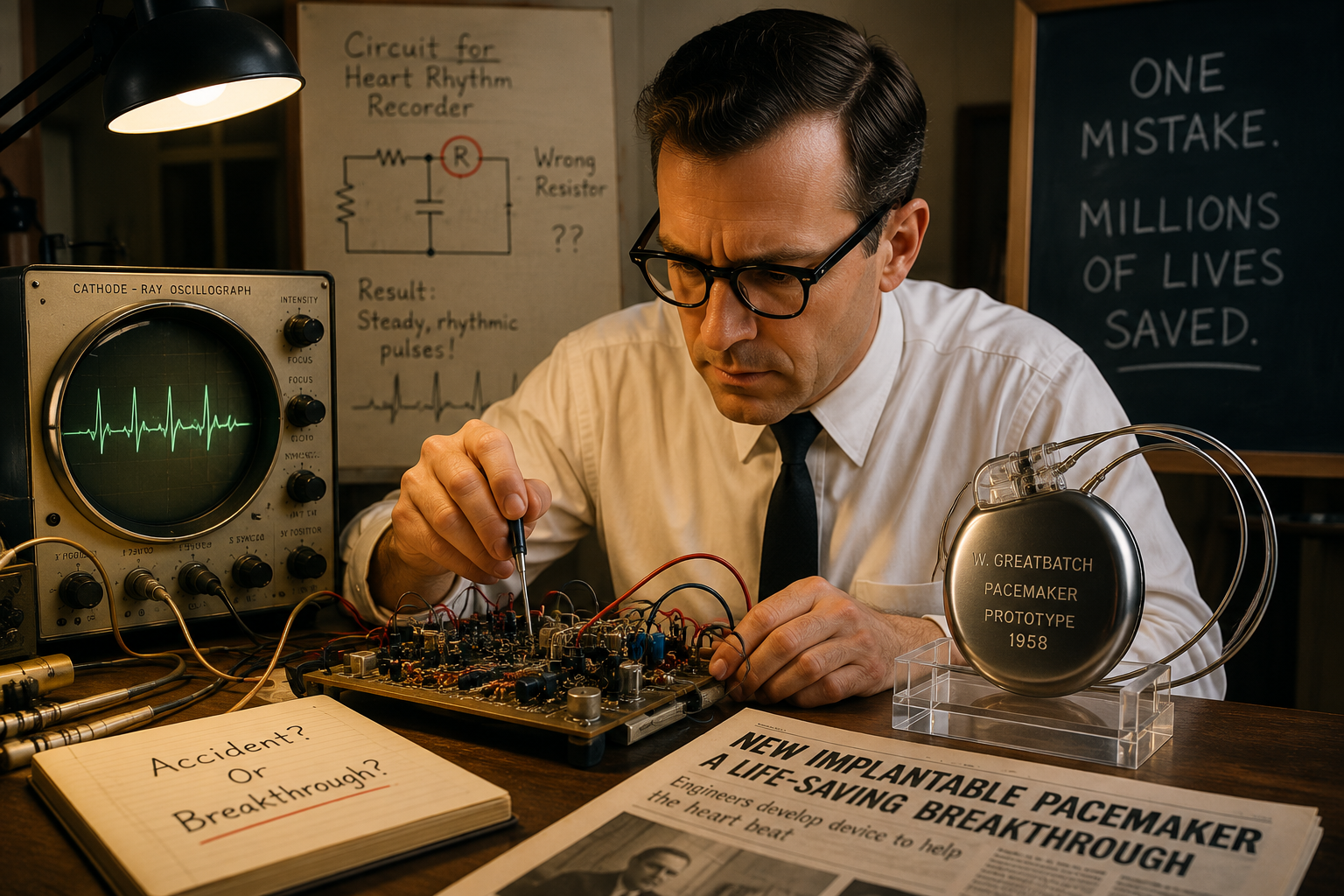
Engineer Wilson Greatbatch working on an electronic circuit in a 1950s laboratory as a prototype implantable pacemaker emits rhythmic electrical pulses, symbolizing the accidental invention that transformed cardiac medicine.

Confidence

🟒 verified

Published

July 2026

Last Updated

July 2026

Version

1.0

⚑ Quick Answer

In 1956, engineer Wilson Greatbatch accidentally inserted the wrong resistor while building a heart rhythm recorder. Instead of failing, the circuit generated regular electrical pulses that closely resembled a heartbeat. The unexpected discovery inspired him to develop the first practical implantable pacemaker, a breakthrough that has since helped millions of people live longer, healthier lives.

Did You Know?

  • β—Ž Wilson Greatbatch discovered the pacemaker circuit by accidentally using the wrong resistor.
  • β—Ž The breakthrough occurred in 1956 while building a heart rhythm recorder.
  • β—Ž Modern pacemakers monitor heart rhythms and deliver electrical pulses only when needed.
  • β—Ž Millions of people worldwide have received implantable pacemakers.
  • β—Ž Wilson Greatbatch later received numerous awards for his contributions to medicine and engineering.

Full Story

The Accidental Invention of the Pacemaker

Some of the world's greatest discoveries happen by accident.

The implantable pacemaker is one of them.

One Wrong Component

In 1956, American engineer **Wilson Greatbatch** was building a device to record heart rhythms.

While assembling the circuit, he accidentally picked up the wrong resistor from a parts box.

Expecting the circuit to fail, he switched it on.

Instead, it produced steady electrical pulses that closely matched the rhythm of a human heartbeat.

A Life-Changing Idea

Greatbatch immediately realized the circuit could do more than record heart activity.

It could actually stimulate the heart.

At the time, pacemakers already existed, but they were large, external devices that limited patients' mobility.

Greatbatch began working to create a compact device that could be safely implanted inside the human body.

A Medical Breakthrough

After years of development and collaboration with physicians, the first practical implantable pacemakers became available.

The devices delivered carefully timed electrical pulses whenever the heart's natural rhythm slowed or became irregular.

Over time, improvements in batteries, electronics, and materials made pacemakers smaller, more reliable, and capable of lasting many years.

Saving Millions of Lives

Today, millions of people around the world rely on implantable pacemakers to maintain healthy heart rhythms.

What started as a simple laboratory mistake became one of the most important advances in modern medicine.

Sometimes Mistakes Change the World

Wilson Greatbatch's story reminds us that curiosity and careful observation can transform an unexpected error into a discovery that benefits humanity for generations.

FAQ

Who invented the implantable pacemaker?

Engineer Wilson Greatbatch developed the first practical implantable pacemaker after his accidental discovery.

How was the pacemaker discovered?

Greatbatch accidentally installed the wrong resistor, causing a circuit to produce heartbeat-like electrical pulses.

What does a pacemaker do?

It helps regulate abnormal heart rhythms by sending small electrical impulses to the heart.

Are pacemakers still used today?

Yes. Modern pacemakers are widely used and have helped millions of people worldwide.

Was the invention really an accident?

The initial discovery was accidental, but years of engineering and medical development were required to turn it into a life-saving medical device.