
Full Story
Atacama Desert: The Driest Place on Earth
Imagine visiting a place where rain is so rare that some locations have gone centuries without experiencing significant rainfall.
Welcome to the Atacama Desert.
Located in northern Chile, it is widely recognized as the driest non-polar desert on Earth.
Why Is It So Dry?
Several natural forces combine to keep the Atacama almost completely dry.
To the east, the towering Andes Mountains block moist air arriving from the Amazon rainforest.
To the west, the cold Humboldt Current cools the air above the Pacific Ocean, reducing evaporation and preventing clouds from producing rain.
Persistent high-pressure systems further suppress cloud formation.
Together, these factors create one of the driest climates anywhere on Earth.
A Landscape Like Mars
The desert's rocky terrain, salt flats, volcanoes, and barren valleys have made it one of the best natural Mars analogues on Earth.
NASA and the European Space Agency regularly use parts of the Atacama to test instruments, robots, and technologies designed for future Mars missions.
Its crystal-clear skies have also made it one of the world's premier locations for astronomical observatories.
When the Impossible Happens
Although the Atacama is famous for its dryness, nature occasionally delivers a surprise.
After unusually heavy rainfall during rare climate events, millions of dormant wildflower seeds awaken.
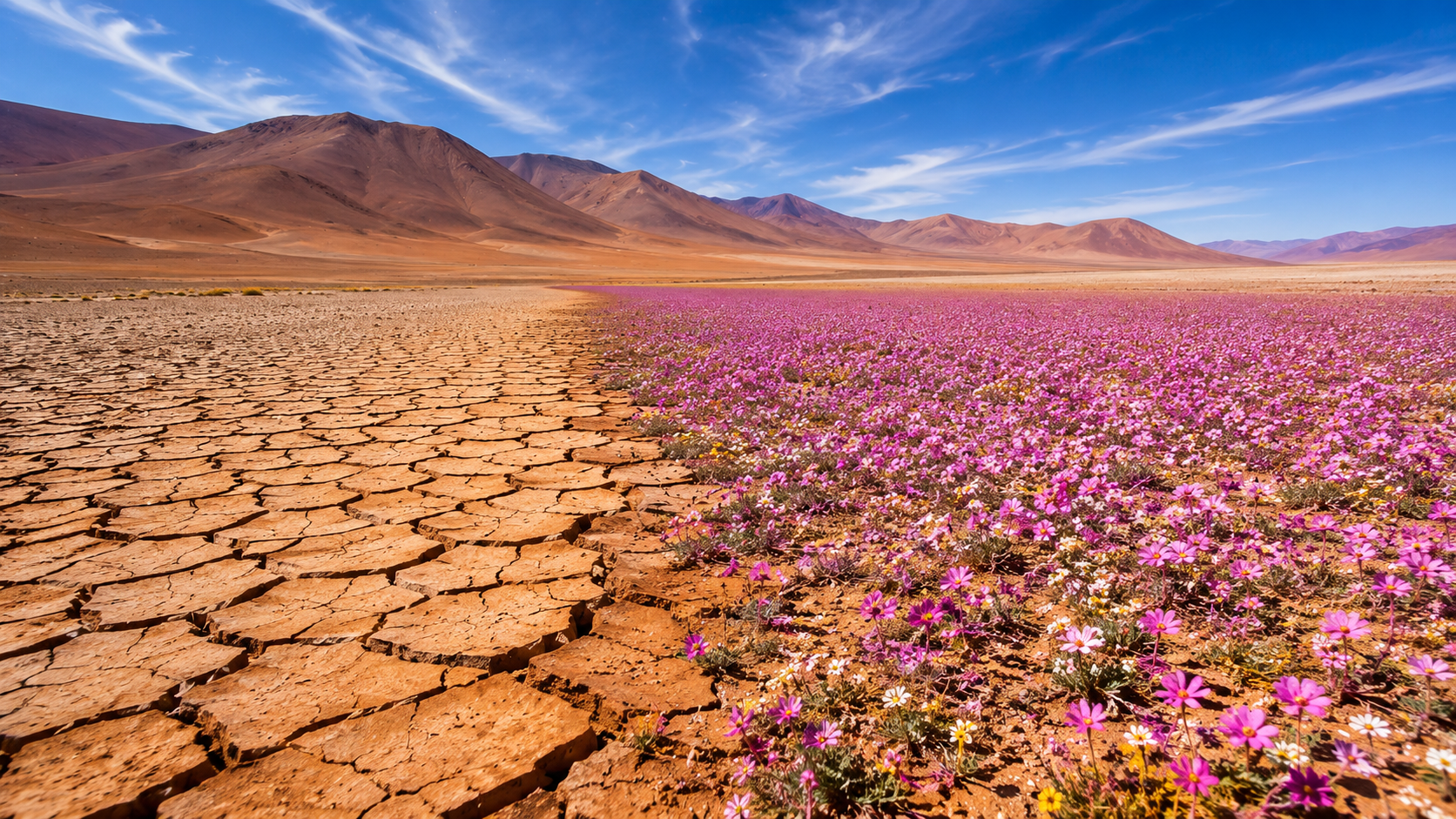
Within weeks, vast areas of the desert become covered with colorful pink, purple, yellow, and white flowers in a spectacular event known as the Desierto Florido, or "Flowering Desert."
The transformation is so dramatic that the same landscape can appear completely lifeless one month and bursting with color the next.
Life Finds a Way
Despite its harsh environment, the Atacama supports specialized plants, insects, reptiles, birds, and microscopic organisms that have adapted to survive with almost no water.
These resilient life forms continue to help scientists understand how organisms might survive in extreme environments—even on other planets.
One of Earth's Greatest Natural Extremes
The Atacama Desert proves that one of the driest places on Earth can also become one of its most beautiful.
Its combination of extreme climate, scientific importance, and rare bursts of life makes it one of the planet's most extraordinary natural wonders.