
Fun & Factopedia logoFun & Factopedia
Homeβ€ΊArticlesβ€ΊAndrew Carnegie: The Steel King Who Built a Fortune

Historical Figures

Andrew Carnegie: The Steel King Who Built a Fortune

Before modern tech billionaires, Andrew Carnegie built an industrial empire that dominated the steel industry. His fortune was so enormous that, adjusted for today's economy, many historians rank him among the wealthiest individuals ever to live.

🟒 verified⏱ 3 min readVersion 1.0
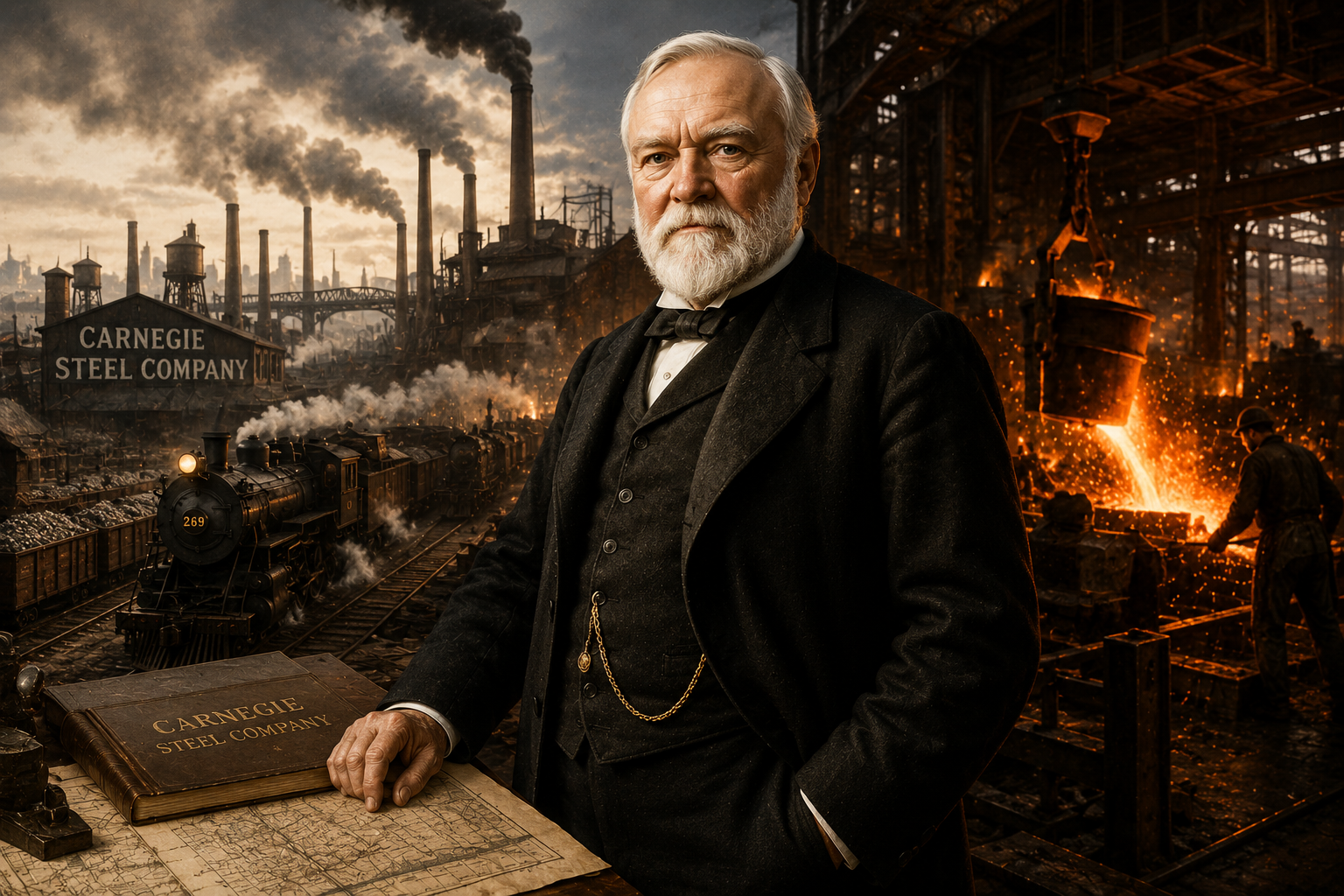
A cinematic portrait of Andrew Carnegie standing inside a massive 19th-century steel mill, glowing molten steel illuminating the factory while smokestacks, railroads, and industrial machinery stretch into the background, symbolizing the steel empire that made him one of history's wealthiest men.

Confidence

🟒 verified

Published

July 2026

Last Updated

July 2026

Version

1.0

⚑ Quick Answer

Andrew Carnegie (1835–1919) was a Scottish-American industrialist who built Carnegie Steel into the largest steel company in the world. After selling the company to J.P. Morgan in 1901 for $480 million (about $15 billion today in inflation-adjusted dollars), Carnegie dedicated most of his remaining life to philanthropy, donating the vast majority of his fortune. Relative to the size of the U.S. economy, historians estimate his wealth would equal several hundred billion dollars today.

Did You Know?

  • β—Ž Andrew Carnegie emigrated from Scotland to the United States at age 12.
  • β—Ž Carnegie Steel became the world's largest steel producer.
  • β—Ž J.P. Morgan purchased Carnegie Steel in 1901.
  • β—Ž The sale helped create U.S. Steel, the world's first billion-dollar corporation.
  • β—Ž Carnegie funded more than 2,500 public libraries around the world.

Full Story

Andrew Carnegie: The Steel King Who Built a Fortune

Andrew Carnegie didn't inherit enormous wealth.

He built it.

Born in **1835** in Scotland, Carnegie's family immigrated to the United States when he was just 12 years old in search of a better life.

He began working in a cotton factory before eventually finding opportunities in the rapidly expanding railroad industry.

Seeing the Future

Carnegie realized that America's future would be built with **steel**.

As railroads expanded, cities grew taller, and bridges stretched farther, demand for steel exploded.

Carnegie invested heavily in new steel-making technologies and built massive, highly efficient mills.

By constantly improving production and reducing costs, Carnegie Steel became the world's largest steel producer.

The Deal That Changed History

In **1901**, financier **J.P. Morgan** purchased Carnegie Steel for **$480 million**.

The company became part of **U.S. Steel**, the world's first corporation valued at over **$1 billion**.

The sale instantly made Carnegie one of the richest people ever to live.

Giving Away a Fortune

Unlike many wealthy industrialists, Carnegie believed:

> "The man who dies rich dies disgraced."

He spent the rest of his life giving away approximately **90% of his fortune**.

His donations funded:

β—Ž More than 2,500 public libraries

β—Ž Universities

β—Ž Museums

β—Ž Scientific research

β—Ž Peace initiatives

Many Carnegie libraries are still operating today.

A Legacy Beyond Wealth

Carnegie's fortune helped build modern America through steel.

His philanthropy helped educate millions through free public libraries.

Few people have influenced both industry and education as profoundly.

One of History's Greatest Industrial Titans

Andrew Carnegie proved that enormous wealth could build an empire...

and then be used to benefit generations long after its creator was gone.

FAQ

Who was Andrew Carnegie?

A Scottish-American industrialist and philanthropist who built Carnegie Steel.

How did Andrew Carnegie become rich?

He dominated the American steel industry during the Industrial Revolution.

How much was Andrew Carnegie worth?

Relative to today's economy, historians estimate his fortune would equal several hundred billion dollars.

What happened to Carnegie Steel?

It was sold to J.P. Morgan in 1901 and became part of U.S. Steel.

What is Andrew Carnegie remembered for today?

Both his steel empire and his extraordinary philanthropy, including thousands of public libraries.