
Fun & Factopedia logoFun & Factopedia
Homeβ€ΊArticlesβ€ΊEmperor Akbar I: The Ruler Whose Empire Rivaled Modern Billionaires

Historical Figures

Emperor Akbar I: The Ruler Whose Empire Rivaled Modern Billionaires

Emperor Akbar ruled one of the wealthiest empires in history. Through military conquest, trade, and economic reforms, he controlled an economy so massive that historians estimate it accounted for a significant share of the world's wealth.

🟒 verified⏱ 3 min readVersion 1.0
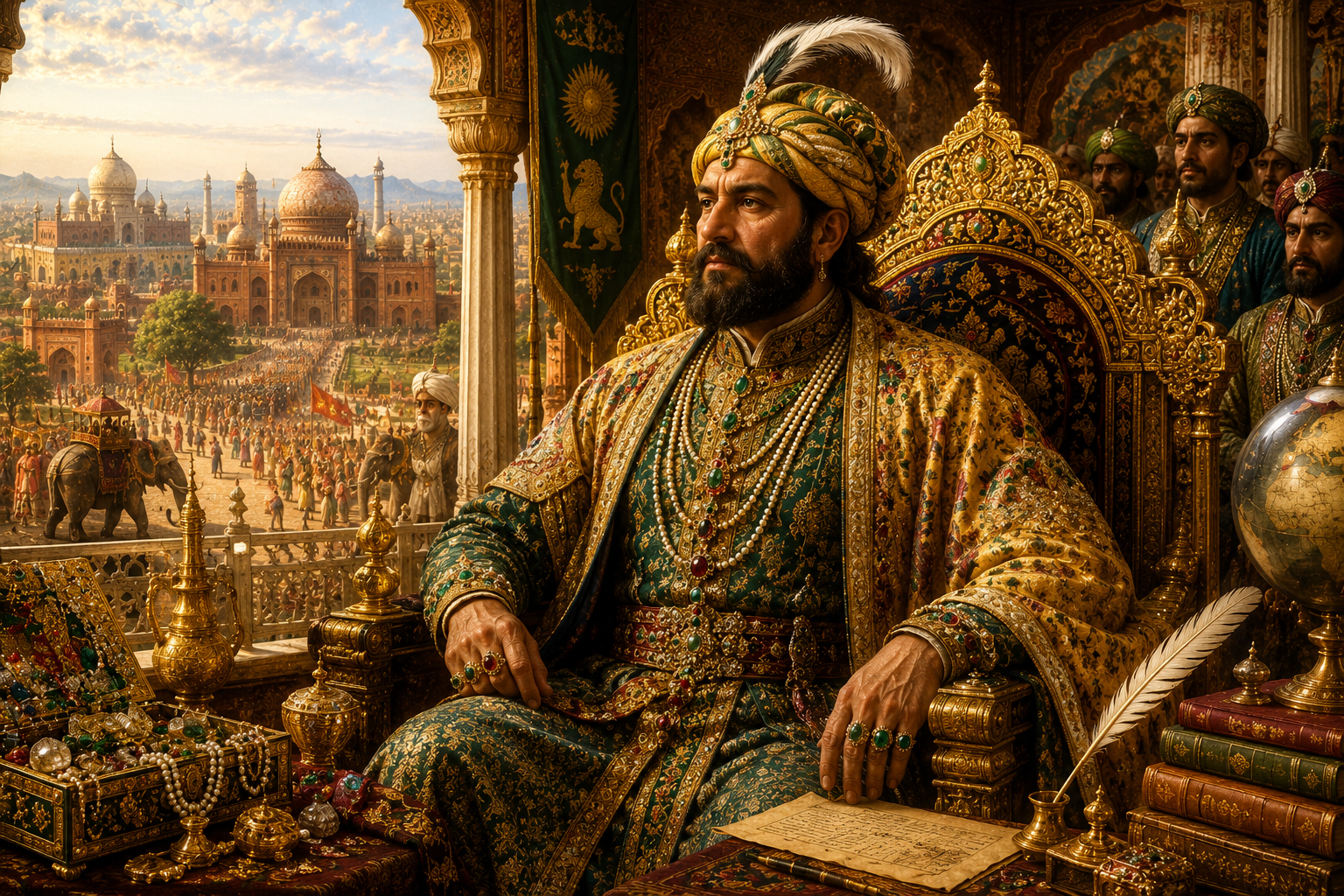
A cinematic portrait of Emperor Akbar seated on an ornate Mughal throne inside a magnificent palace, surrounded by gold, jewels, royal courtiers, richly decorated arches, and a sprawling imperial city visible beyond, symbolizing the immense wealth and power of the Mughal Empire.

Confidence

🟒 verified

Published

July 2026

Last Updated

July 2026

Version

1.0

⚑ Quick Answer

Akbar I (1542–1605), also known as Akbar the Great, was the third Mughal emperor of India. During his reign, the Mughal Empire became one of the richest and most powerful states in the world. Historians estimate that around the year 1600, the empire produced roughly 22–25% of the world's economic output. Although Akbar did not personally own every resource within the empire, he controlled one of history's largest concentrations of wealth and power.

Did You Know?

  • β—Ž Akbar became emperor at just 13 years old.
  • β—Ž His reign lasted nearly 50 years.
  • β—Ž The Mughal Empire produced roughly one-quarter of the world's economic output around 1600.
  • β—Ž Akbar introduced major tax and administrative reforms.
  • β—Ž He is remembered as one of India's greatest rulers.

Full Story

Emperor Akbar I: The Ruler Whose Empire Rivaled Modern Billionaires

When Akbar became emperor in **1556**, he was only **13 years old**.

Few could have imagined he would go on to build one of the greatest empires in history.

Building a Superpower

Over nearly five decades, Akbar expanded the Mughal Empire across much of northern and central India.

His armies conquered vast territories while his administration created one of the most efficient governments of its time.

The empire flourished through:

β—Ž Agriculture

β—Ž International trade

β—Ž Textile production

β—Ž Precious stones

β—Ž Spices

β—Ž Metalworking

One of the World's Richest Economies

By the early 1600s, the Mughal Empire is estimated to have produced around **22–25% of the world's GDP**.

That made it one of the largest and wealthiest economies on Earth.

While this wealth belonged to the empire rather than Akbar personally, the emperor controlled enormous financial and political resources unmatched by most rulers in history.

More Than a Conqueror

Akbar was also known for his reforms.

He modernized taxation, encouraged commerce, improved infrastructure, and promoted religious tolerance among his diverse population.

His court became a center of art, architecture, literature, and scientific learning.

A Lasting Legacy

Many of India's greatest Mughal monuments and institutions trace their origins to Akbar's reign.

His administrative system influenced governments for centuries.

Wealth Beyond Imagination

Modern billionaires measure wealth in company shares.

Akbar measured it in an empire.

At the height of his reign, he controlled one of the largest concentrations of economic power the world had ever seen.

FAQ

Who was Emperor Akbar?

The third Mughal emperor, widely known as Akbar the Great.

Why was Akbar so wealthy?

He ruled one of the world's largest and richest empires during the 16th century.

Did Akbar personally own all of the empire's wealth?

No. He controlled the empire and its resources, but much of the wealth belonged to the state and its economy.

What made Akbar famous besides wealth?

His military expansion, administrative reforms, and promotion of religious tolerance.

How large was the Mughal Empire under Akbar?

It covered much of the Indian subcontinent and was among the world's largest empires.