
Full Story
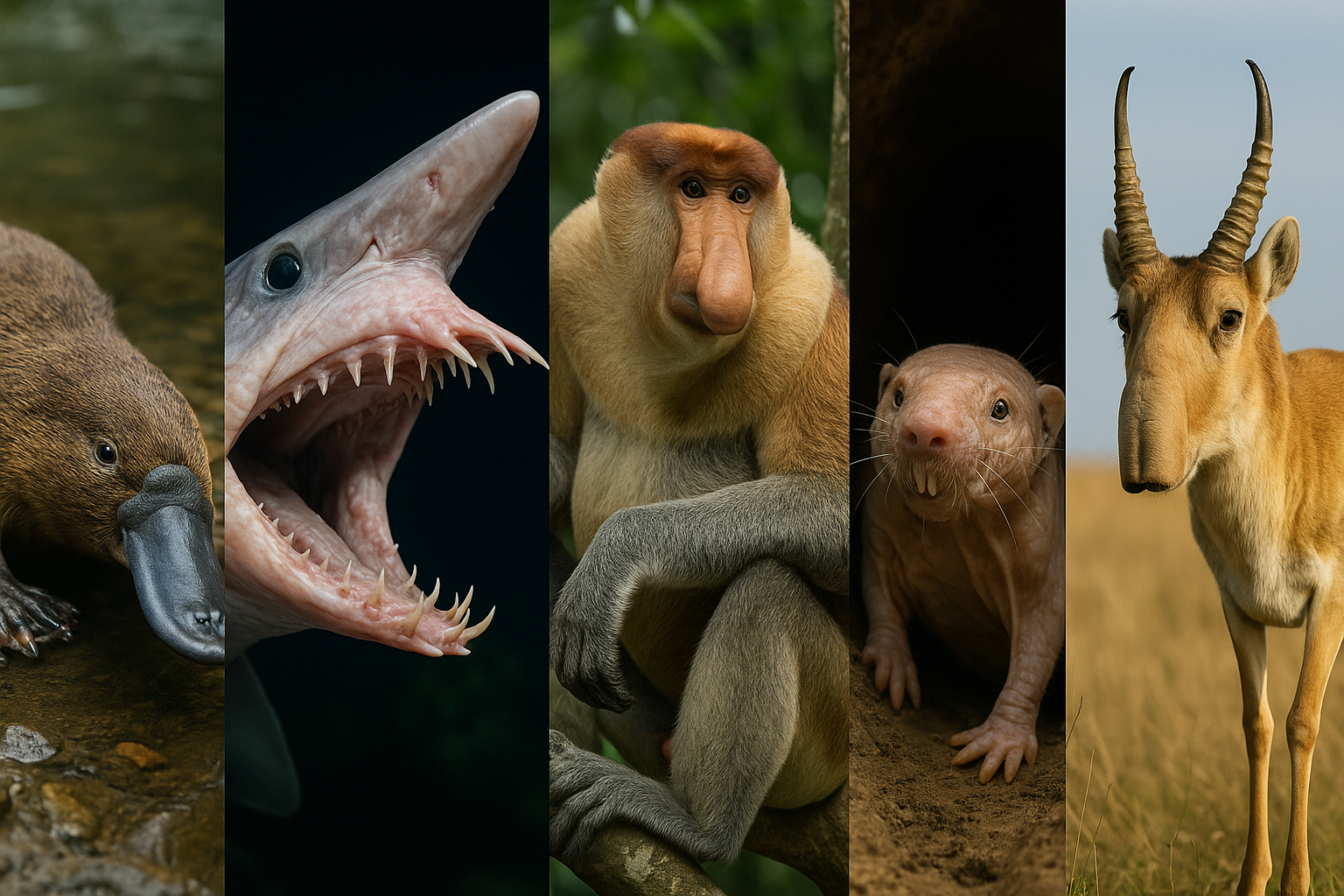
5 Animals That Look Like Nature Gave Up
Some creatures are so unusual that they seem completely made up. Yet every one of these animals is perfectly real and uniquely adapted to survive.
1. Platypus
The Platypus looks like someone combined a duck, a beaver, and an otter.
It lays eggs despite being a mammal, has webbed feet, uses electroreception to hunt underwater, and males even possess venomous spurs on their hind legs.
It's one of the most extraordinary mammals on Earth.
2. Goblin Shark
Often called a "living fossil," the Goblin Shark lives in deep oceans where sunlight never reaches.
Its long flattened snout and extendable jaws can shoot forward in an instant to capture prey, creating one of the strangest feeding mechanisms in the animal kingdom.
3. Proboscis Monkey
Found on the island of Borneo, the Proboscis Monkey is famous for its enormous nose.
Scientists believe the oversized nose helps amplify vocal calls and may play a role in attracting mates, making this unusual feature surprisingly useful.
4. Naked Mole Rat
Hairless, wrinkled, and almost blind, the Naked Mole Rat hardly resembles a typical mammal.
It lives in underground colonies led by a queen, much like ants or bees, and has remarkable resistance to pain and certain forms of cancer.
5. Saiga Antelope
The Saiga Antelope's oversized inflatable-looking nose may seem odd, but it serves an important purpose.
The unusual structure filters dust during migration and warms freezing air before it reaches the lungs, helping the animal survive harsh environments.
Weird but Perfectly Designed
What appears strange to us is often an evolutionary masterpiece.
Every unusual nose, jaw, wrinkle, or bill evolved because it helped these animals survive, proving that nature's creativity is far more impressive than anything humans could imagine.