
Full Story
The Frog That Freezes Solid... Then Comes Back to Life
Imagine your heart stopping...
your blood freezing...
and then waking up months later.
For the wood frog, that's simply winter.
Preparing for Winter
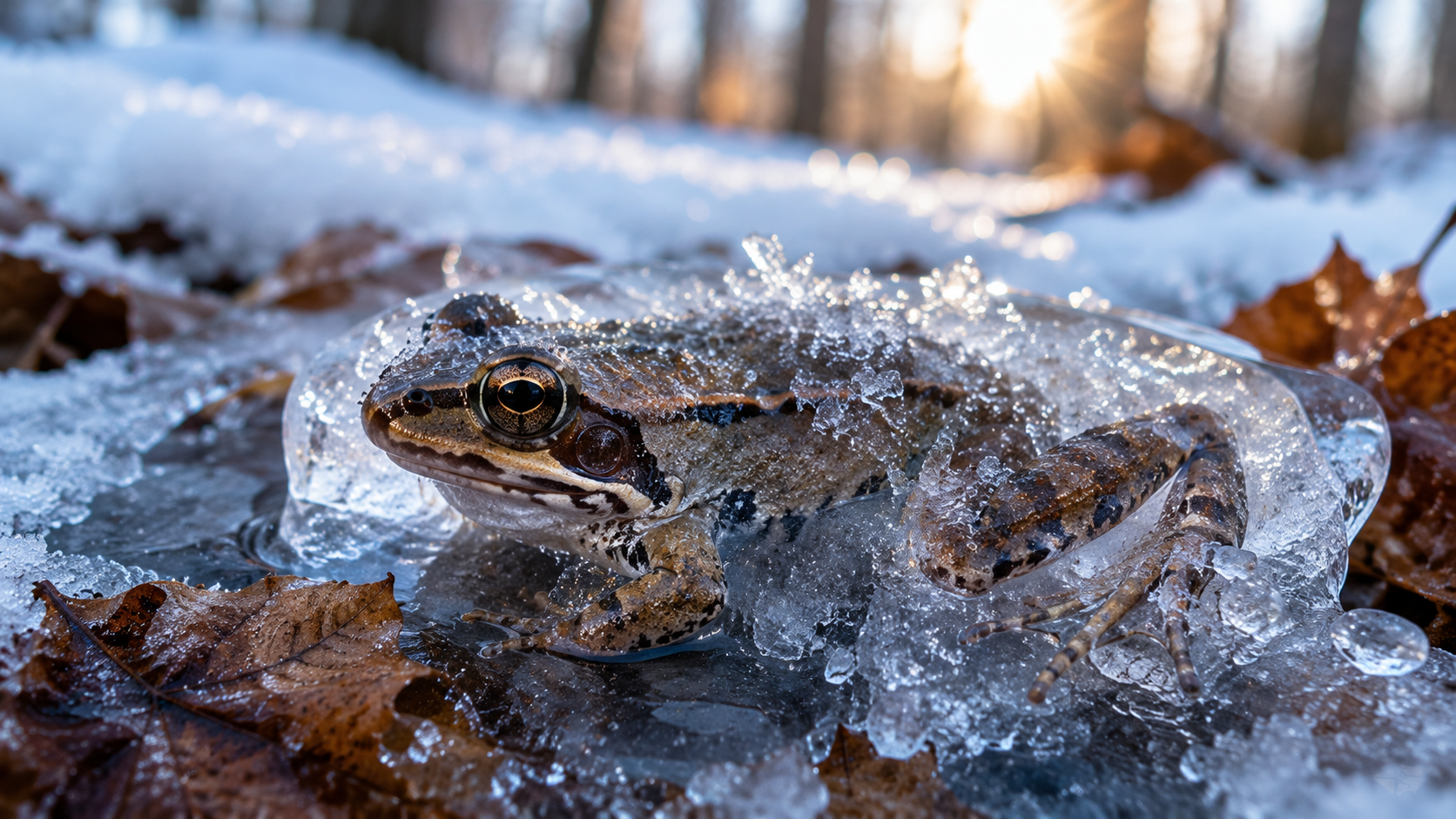
As temperatures drop below freezing, ice begins forming on the frog's skin and in the spaces between its cells.
Unlike humans, the frog carefully controls where ice forms.
By allowing water outside the cells to freeze first, the frog reduces the risk of sharp ice crystals rupturing its cells.
Soon, nearly two-thirds of the water in its body becomes ice.
Its heartbeat stops.
Its breathing stops.
Its blood no longer circulates.
For all practical purposes, the frog appears dead.
Nature's Antifreeze
The secret to its survival lies inside its liver.
As freezing begins, the liver rapidly converts stored glycogen into enormous amounts of glucose and releases it into the bloodstream.
Within hours, glucose concentrations throughout the body increase dramatically.
This glucose does not prevent the frog from freezing.
Instead, it acts as a cryoprotectant.
Because glucose dissolves in water, it helps lower the freezing point inside cells and reduces the amount of ice that forms within them.
Just as importantly, glucose helps keep cells from shrinking too much as water leaves them to join the growing ice outside.
This protects delicate cell membranes and proteins from severe damage during the freezing process.
Scientists sometimes compare it to a natural antifreeze, although unlike the antifreeze used in cars, it is completely safe for the frog's own tissues.
Waiting for Spring
Throughout winter, the frog remains frozen beneath leaves and snow.
Its metabolism slows to almost zero while it survives entirely on stored energy.
Then, as temperatures rise above freezing, the ice gradually melts.
The heart begins beating again.
Blood starts flowing.
Breathing resumes.
Within hours, the frog regains consciousness and hops away to begin feeding and breeding.
A Survival Strategy Millions of Years in the Making
The wood frog's remarkable ability has fascinated scientists for decades.
Researchers studying cryobiology hope its natural freeze-tolerance may one day improve methods for preserving human organs, tissues, and even transplant medicine.
For now, the wood frog remains one of nature's greatest examples of surviving conditions that would be fatal to almost every other vertebrate.