
Fun & Factopedia logoFun & Factopedia
HomeArticlesThe Man Who Turned a Barren Wasteland Into a Forest

Environmental Heroes

The Man Who Turned a Barren Wasteland Into a Forest

Armed with nothing more than determination and tree seedlings, one man transformed a barren sandbar into a thriving forest spanning more than 1,300 acres. His story is one of the greatest environmental success stories ever told.

🟢 verified3 min readVersion 1.0
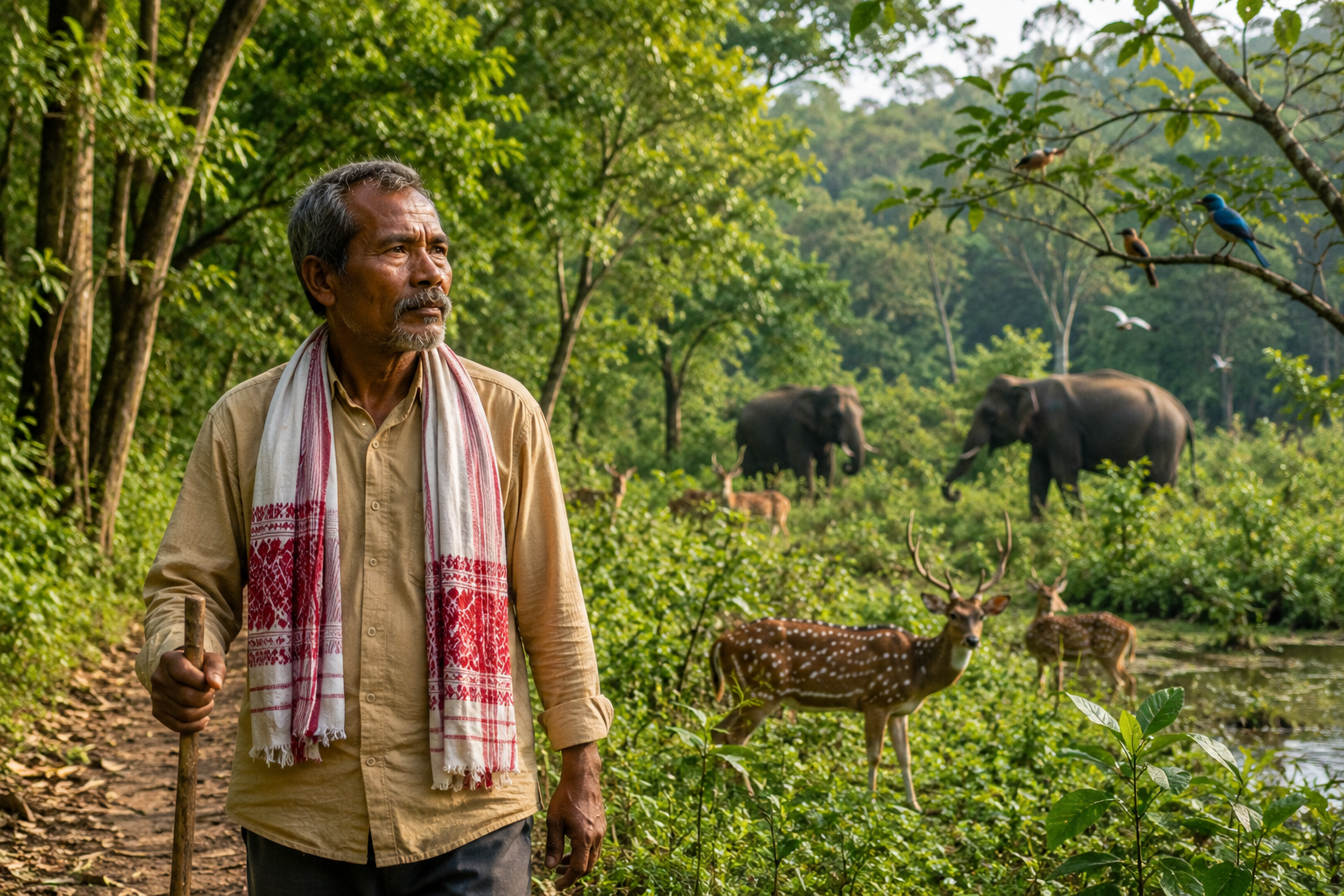
Jadav Payeng walking through the lush Molai Forest he created, surrounded by towering trees and vibrant greenery, illustrating one of the world's greatest individual conservation achievements.

Confidence

🟢 verified

Published

July 2026

Last Updated

July 2026

Version

1.0

⚡ Quick Answer

Jadav Payeng, often called the "Forest Man of India," spent decades planting trees on a barren sandbar along the Brahmaputra River in Assam. His work transformed more than 1,300 acres into the Molai Forest, which is now home to elephants, deer, birds, rhinos, tigers, and countless other species.

Did You Know?

  • Jadav Payeng is widely known as the "Forest Man of India."
  • He began planting trees in 1979.
  • The Molai Forest covers more than 1,300 acres.
  • The forest is located on Majuli Island in Assam, India.
  • Jadav Payeng received India's Padma Shri award in 2015.

Full Story

The Man Who Turned a Barren Wasteland Into a Forest

In 1979, a young man named **Jadav Payeng** noticed something heartbreaking.

After flooding along the Brahmaputra River in Assam, India, hundreds of snakes had been washed onto a barren sandbar.

With no trees to provide shade, many of them died from the intense heat.

The sight changed his life forever.

One Tree at a Time

Rather than waiting for someone else to solve the problem, Payeng decided to act.

He began planting bamboo.

Then more trees.

Then even more.

Day after day.

Year after year.

For decades, he continued planting and caring for the growing forest almost entirely by himself.

A Forest Is Born

Slowly, the once-empty sandbar transformed.

Small plants became young trees.

Young trees became a dense forest.

Today, the area—known as **Molai Forest**—covers more than **1,300 acres (over 520 hectares)**.

Wildlife Returned

As the forest expanded, wildlife returned.

Today it supports a remarkable variety of animals, including:

Elephants

Deer

Monkeys

Wild boar

Hundreds of bird species

Bengal tigers

Indian rhinoceroses

What was once barren land has become a thriving ecosystem.

International Recognition

Payeng's extraordinary work eventually attracted global attention.

He has received numerous awards for conservation, including one of India's highest civilian honors, the **Padma Shri**, recognizing his extraordinary contribution to protecting the environment.

One Person Really Can Make a Difference

Many people believe environmental change requires massive organizations.

Jadav Payeng proved that lasting change can begin with one person planting a single tree.

His forest continues to grow—and so does his legacy.

FAQ

Who is Jadav Payeng?

He is an Indian environmental activist known for creating the Molai Forest.

How large is the forest he planted?

It covers more than 1,300 acres (over 520 hectares).

Why did he begin planting trees?

He wanted to restore barren land after seeing wildlife suffer from the lack of trees.

What animals live in the forest?

Elephants, deer, birds, wild boar, Bengal tigers, Indian rhinoceroses, and many other species.

Where is the Molai Forest?

On Majuli Island in Assam, India, along the Brahmaputra River.