
Fun & Factopedia logoFun & Factopedia
HomeArticlesDragonflies: Nature's Most Perfect Hunters

Insects

Dragonflies: Nature's Most Perfect Hunters

They may look delicate, but dragonflies are among the deadliest hunters on Earth. Their incredible eyesight, lightning-fast reflexes, and aerial agility allow them to catch nearly every prey they pursue.

🟢 verified3 min readVersion 1.0
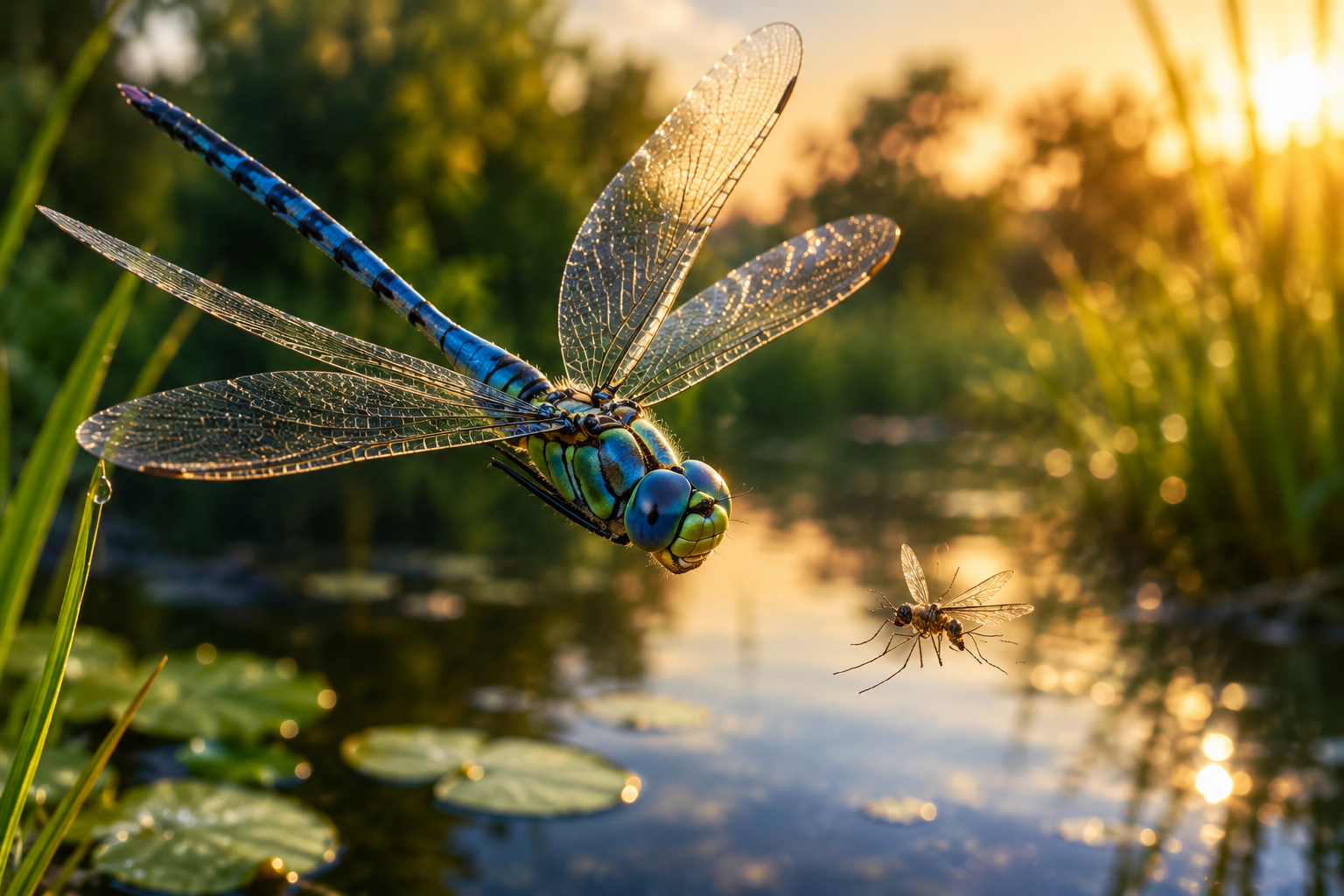
A vibrant blue dragonfly hovering above a tranquil pond while locking onto a flying mosquito, its four transparent wings frozen in motion and its enormous compound eyes sharply focused in warm golden sunlight.

Confidence

🟢 verified

Published

July 2026

Last Updated

July 2026

Version

1.0

⚡ Quick Answer

Dragonflies are among the most successful predators in the animal kingdom, with hunting success rates approaching 95% in some studies. Their enormous compound eyes, independently controlled wings, and remarkable flight abilities allow them to intercept prey with extraordinary precision.

Did You Know?

  • Dragonflies have existed for over 300 million years.
  • Their compound eyes can contain up to 30,000 lenses.
  • They can fly forward, backward, sideways, hover, and even upside down briefly.
  • Dragonflies can catch about 95% of the prey they pursue.
  • Ancient dragonfly relatives had wingspans exceeding 70 centimeters (28 inches).

Full Story

Dragonflies: Nature's Most Perfect Hunters

If you were a mosquito...

A dragonfly would be one of your worst nightmares.

Despite their elegant appearance, dragonflies are among the most efficient predators on the planet.

Built for the Hunt

Dragonflies possess nearly **360-degree vision** thanks to their enormous compound eyes, which contain up to **30,000 individual lenses**.

This allows them to detect even the slightest movement while tracking prey in every direction.

Their brains can also predict where a moving insect will be moments later, allowing them to intercept it rather than simply chase it.

Masters of Flight

Unlike most insects, dragonflies control each of their **four wings independently**.

This gives them extraordinary agility.

They can:

Hover like a helicopter.

Fly straight up or down.

Instantly change direction.

Fly backward.

Reach speeds of about **35 miles per hour (56 km/h)**.

Very few insects can match their aerial precision.

A 95% Hunting Success Rate

Studies have shown dragonflies successfully capture their target in approximately **95% of hunting attempts**.

For comparison, many large predators—including lions and sharks—have much lower success rates.

Dragonflies don't simply react.

They calculate where prey will be and intercept it with astonishing accuracy.

Ancient Survivors

Dragonflies first appeared more than **300 million years ago**, long before dinosaurs walked the Earth.

Some prehistoric relatives had wingspans exceeding **70 centimeters (28 inches)**, making them among the largest insects ever to exist.

Tiny Predator. Incredible Design.

Dragonflies help control mosquito populations and play an important role in freshwater ecosystems around the world.

Their incredible eyesight, flight mechanics, and hunting ability continue to inspire scientists studying robotics, aviation, and artificial intelligence.

Sometimes nature engineers perfection long before humans ever imagine it.

FAQ

Why are dragonflies such successful hunters?

Their exceptional eyesight, predictive brain processing, and highly maneuverable flight allow them to intercept prey with remarkable accuracy.

Can dragonflies fly backward?

Yes. They are among the few insects capable of flying backward as well as hovering and changing direction instantly.

How good is a dragonfly's vision?

Its compound eyes provide nearly 360-degree vision and contain up to 30,000 individual lenses.

How old are dragonflies as a species?

Dragonflies first appeared more than 300 million years ago.

Do dragonflies help humans?

Yes. They naturally reduce mosquito populations and contribute to healthy freshwater ecosystems.