
Fun & Factopedia logoFun & Factopedia
Homeβ€ΊArticlesβ€ΊCatatumbo Lightning: The Place Where Lightning Never Seems to Stop

Weather Phenomena

Catatumbo Lightning: The Place Where Lightning Never Seems to Stop

Imagine watching lightning flash across the sky for hours without rain. At Venezuela's Lake Maracaibo, this incredible natural phenomenon occurs so often that it has become one of the most electrifying places on Earth.

🟒 verified⏱ 3 min readVersion 1.0
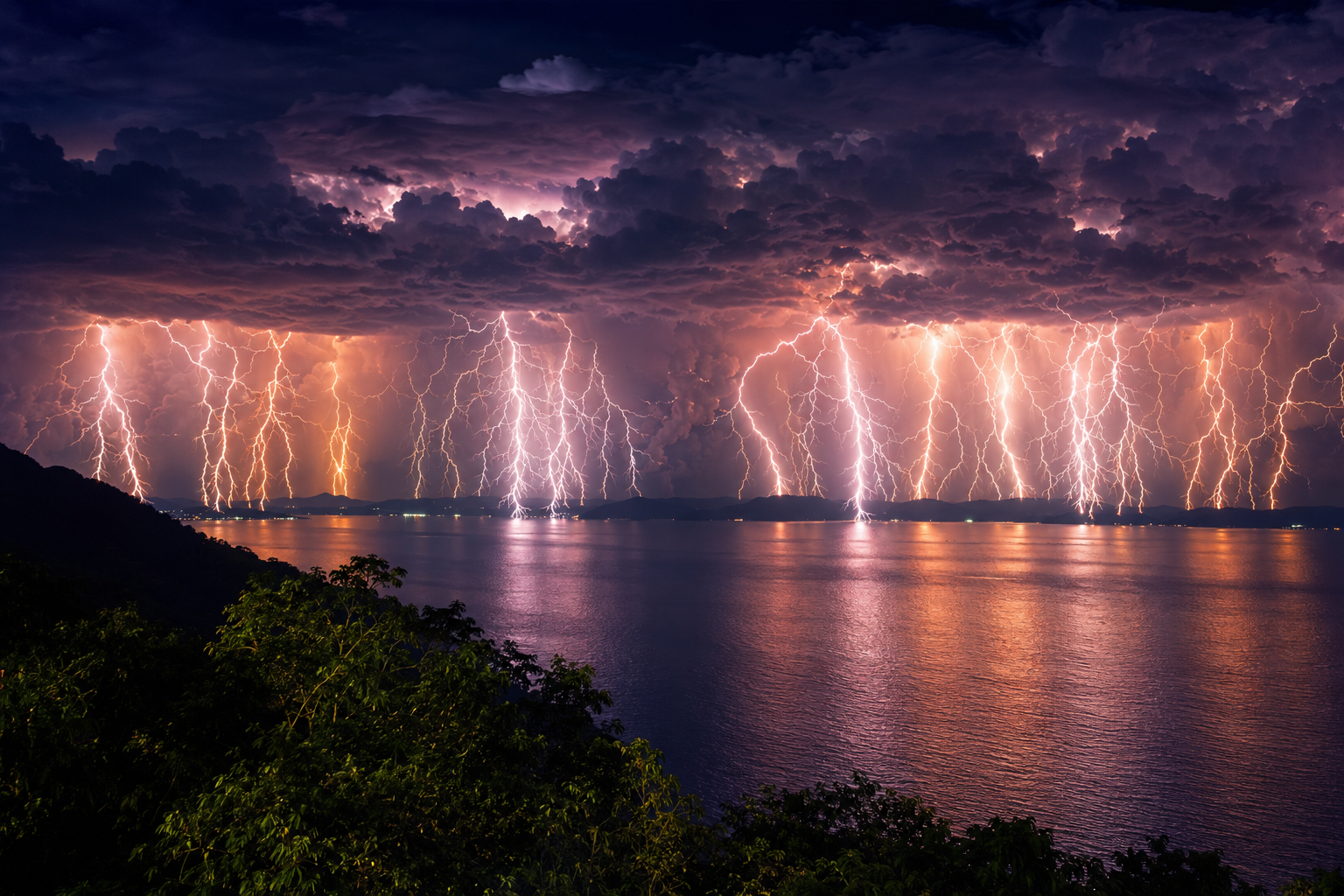
Brilliant lightning bolts repeatedly illuminating dark thunderclouds above Lake Maracaibo in Venezuela, reflecting across calm water while distant mountains frame one of the world's most spectacular natural weather phenomena.

Confidence

🟒 verified

Published

July 2026

Last Updated

July 2026

Version

1.0

⚑ Quick Answer

Catatumbo Lightning is a unique weather phenomenon that occurs near the mouth of the Catatumbo River where it flows into Lake Maracaibo in Venezuela. Warm, humid air from the Caribbean collides with cooler mountain air from the Andes, creating powerful thunderstorms that can produce hundreds of lightning flashes per hour on many nights of the year.

Did You Know?

  • β—Ž Catatumbo Lightning occurs near Lake Maracaibo in Venezuela.
  • β—Ž The storms can produce hundreds of lightning flashes per hour.
  • β—Ž The phenomenon has been observed for centuries.
  • β—Ž Sailors historically used the lightning as a natural navigation beacon.
  • β—Ž The surrounding Andes Mountains help create the unique weather conditions.

Full Story

Catatumbo Lightning: The Place Where Lightning Never Seems to Stop

Imagine looking toward the horizon...

...and seeing lightning flash almost continuously for hours.

No special effects.

No science fiction.

Just nature.

A Lightning Hotspot

Catatumbo Lightning occurs where the **Catatumbo River** flows into **Lake Maracaibo** in northwestern Venezuela.

The region experiences thunderstorms on an astonishing number of nights each year.

During active periods, observers may witness **hundreds of lightning flashes every hour**, illuminating the sky throughout the night.

Why Does It Happen?

The phenomenon is created by a rare combination of geography and weather.

Several natural ingredients come together:

β—Ž Warm, moisture-rich air rises from Lake Maracaibo.

β—Ž Cooler, denser air flows down from the surrounding Andes Mountains.

β—Ž The collision of these air masses creates powerful storm clouds.

β—Ž Electrical charges build rapidly inside the clouds, producing frequent lightning.

The basin-shaped landscape helps trap these weather patterns, allowing storms to form repeatedly.

One of Earth's Greatest Light Shows

Catatumbo Lightning has been observed for centuries.

Sailors once used the nearly constant flashes as a natural lighthouse while navigating nearby waters.

The phenomenon has even been nicknamed **"The Everlasting Storm."**

A Scientific Wonder

Researchers continue studying Catatumbo Lightning to better understand thunderstorm formation, atmospheric electricity, and regional climate patterns.

Although the storms are spectacular, they also play an important role in the area's weather system.

Nature's Greatest Fireworks

Catatumbo Lightning proves that some of Earth's most astonishing natural displays happen not once in a lifetimeβ€”but almost every night.

For anyone lucky enough to witness it, the sky becomes a dazzling theater of light unlike anywhere else on the planet.

FAQ

Where does Catatumbo Lightning occur?

Near the mouth of the Catatumbo River where it flows into Lake Maracaibo in Venezuela.

Why does Catatumbo Lightning happen?

Warm humid air collides with cooler mountain air, creating frequent thunderstorms.

How often does Catatumbo Lightning occur?

It occurs on many nights throughout the year, although activity varies seasonally.

Can tourists see Catatumbo Lightning?

Yes. Guided boat tours operate when weather conditions are favorable.

Is Catatumbo Lightning dangerous?

Like all thunderstorms, it can be dangerous if approached closely, so visitors should observe it safely with experienced guides.